🗓️Published on: 03/11/2026
Publicly available documents and photographs, together with a decision issued by the General Secretariat of the General Union of Algerian Workers (UGTA), raise serious questions about how Law No. 23-02 on the exercise of trade union rights is applied and whether trade union organisations across Algeria are subject to the same legal requirements and oversight mechanisms.
View full size
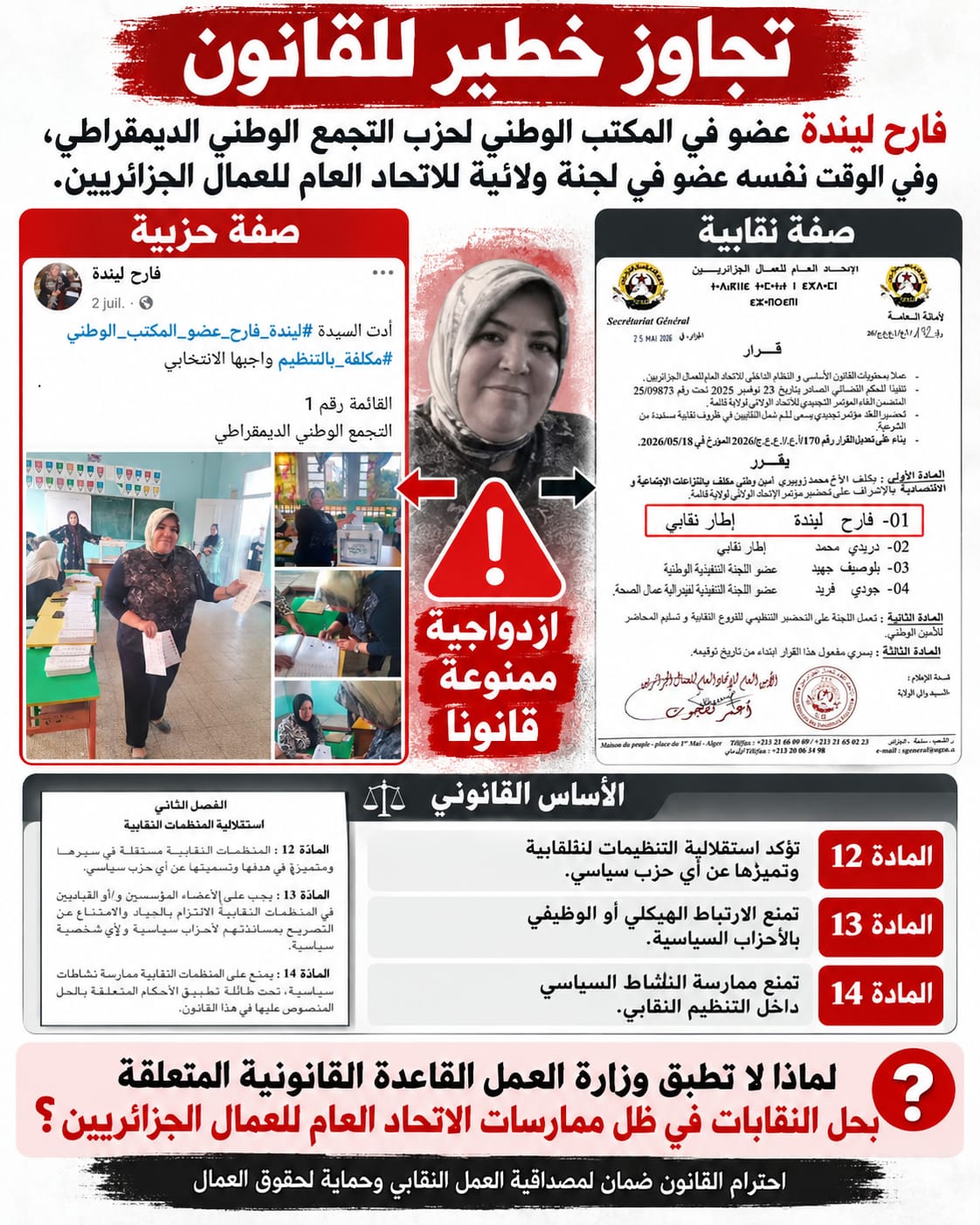
COSYFOP graphic illustrating breaches of Law No. 23-02 on the exercise of trade union rights.
Illustration prepared by COSYFOP highlighting questions about the application of Law No. 23-02. فتح الصورة في نافذة جديدة
The case concerns Ms Linda Farah, who is identified as a member of the National Bureau of the National Democratic Rally (RND) while also serving on a committee responsible for managing the provincial branch of the General Union of Algerian Workers (UGTA) in Guelma.
The question is not whether she is entitled to join a political party or a trade union, since the law itself protects union members’ freedom to join political parties individually. Rather, it concerns the responsibilities she holds in each organisation and whether combining those roles is compatible with the statutory separation of trade union leadership from the governing bodies of political parties.
The documents examined by COSYFOP directly raise the question of compliance with Article 12 of Law No. 23-02, which prohibits a person from simultaneously holding a mandate on a trade union’s leadership and/or management body and a mandate on a political party’s governing body. In certain circumstances, breaches of the provisions governing relations between unions and political parties may also provide grounds for seeking judicial dissolution.
Two documented facts that require scrutiny by the Labour Ministry
On 22 November 2025, Algerian media reported on an RND event in the province of Sétif, explicitly identifying Linda Farah as a “member of the party’s National Bureau” and stating that she had overseen the event at the request of the RND’s Secretary-General.
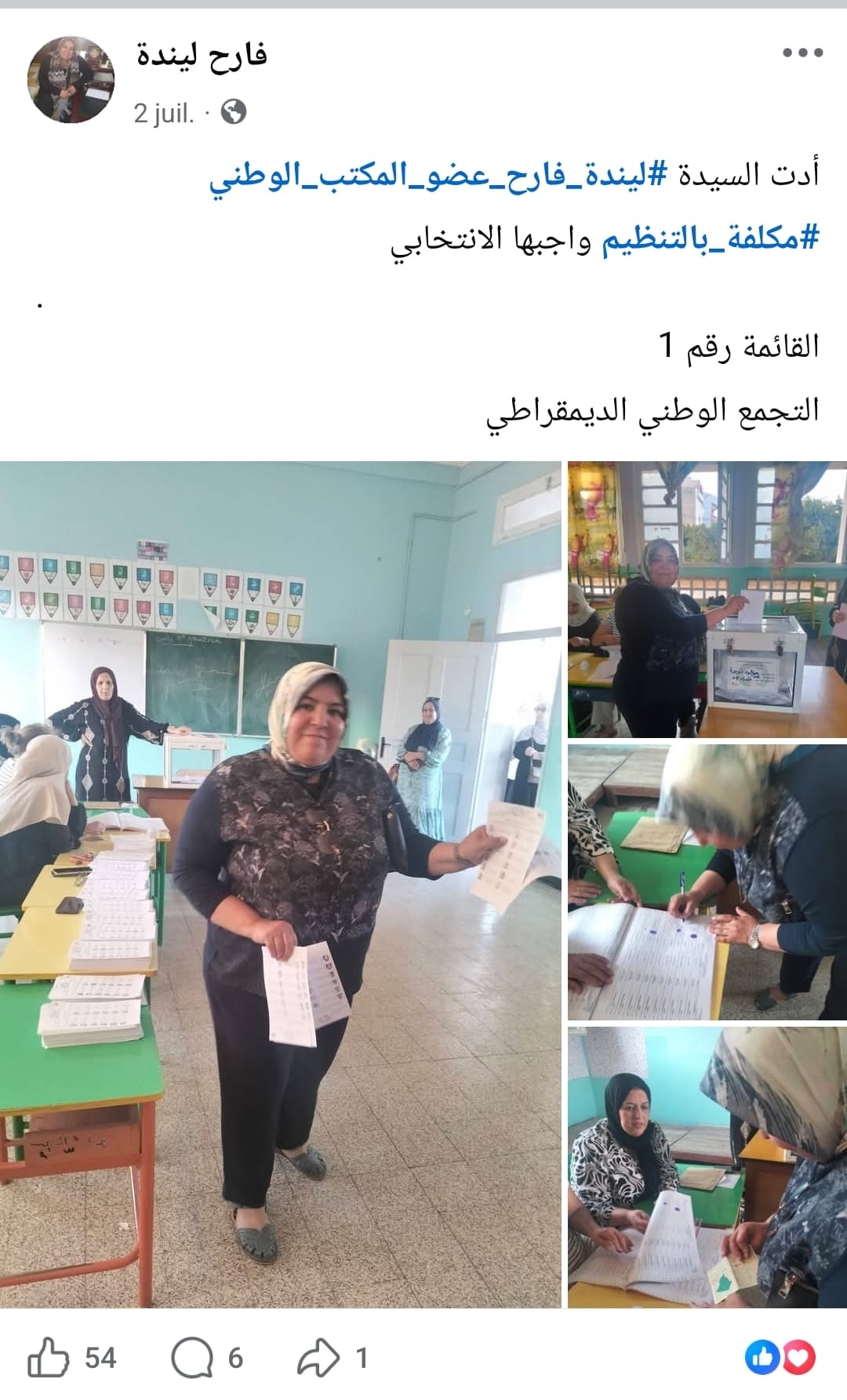
Documents retained by COSYFOP also indicate that she continued to hold that party position: a public post under Linda Farah’s name refers to her participation in an RND election-related event in the summer of 2026, identifying her as a member of the National Bureau responsible for organisation.
View full size
Public post under Linda Farah’s name presenting her as a National Bureau member of the National Democratic Rally, responsible for organisation. فتح الصورة في نافذة جديدة
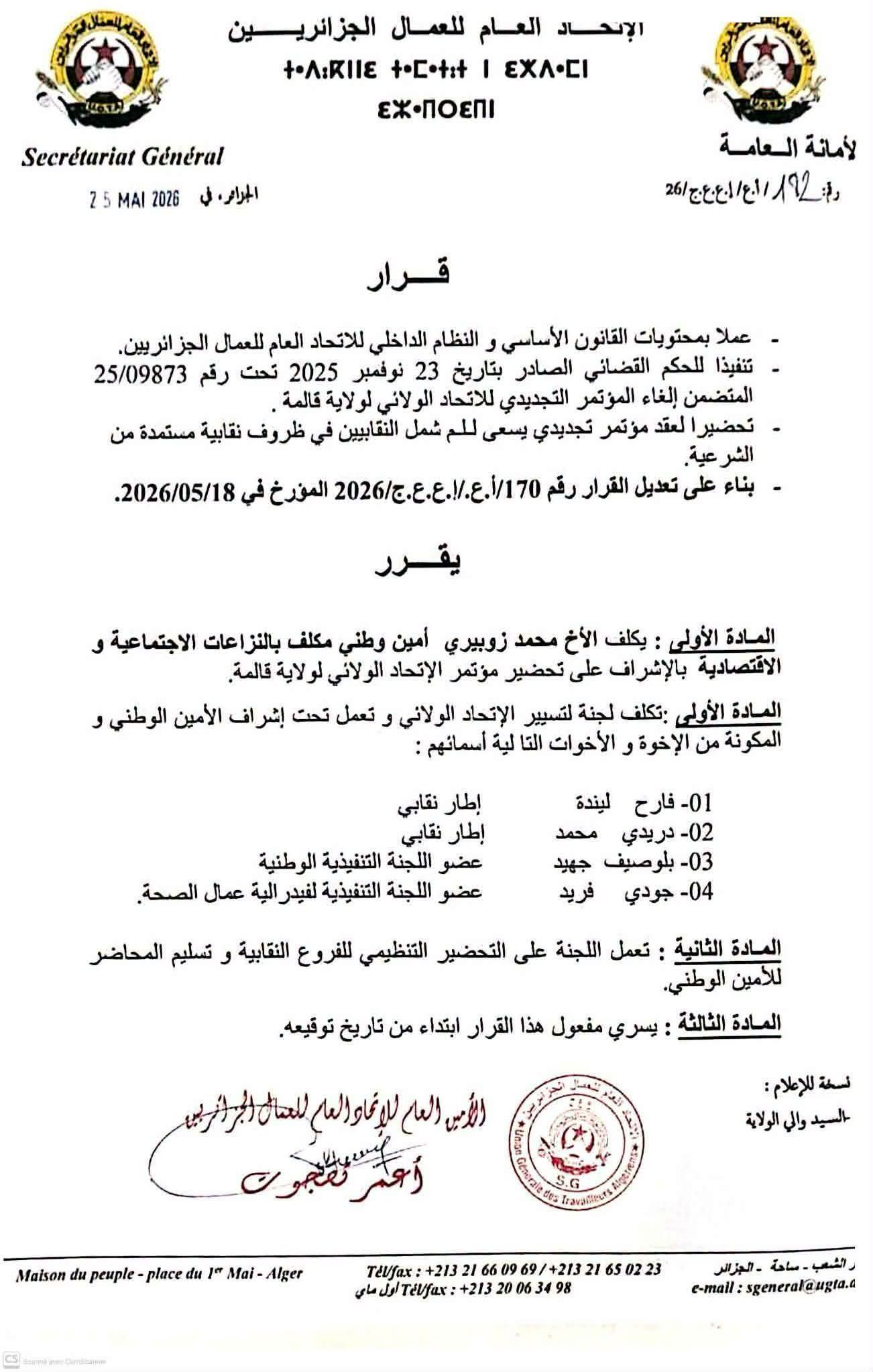
At the same time, a decision issued by the UGTA General Secretariat on 25 May 2026 established a committee to manage the union’s provincial branch in Guelma and prepare for its renewal congress. The decision names Linda Farah as a committee member and explicitly describes her as a “trade union official”.
View full size
The UGTA General Secretariat’s decision of 25 May 2026 lists Linda Farah among the members of the committee managing its Guelma provincial branch, in the capacity of a “trade union official”. فتح الصورة في نافذة جديدة
The legal significance is precise: Law No. 23-02 does not, in itself, prohibit a worker or trade unionist from joining a political party. It prohibits holding a mandate within a union’s leadership and/or management body at the same time as a mandate within a political party’s governing bodies; according to the appointment record, her position as a trade union official involves managing one of her organisation’s local union structures.
What does Law No. 23-02 actually provide?
aw No. 23-02 of 25 April 2023, which the UGTA itself helped bring about, established the principle that trade union organisations must remain independent of political parties. It was published in Issue No. 29 of the Official Gazette on 2 May 2023.
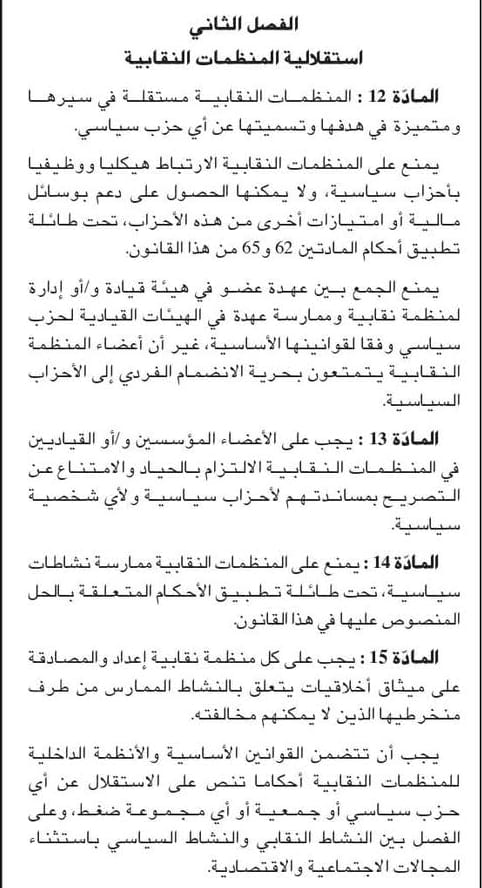
Relevant provisions as published in the Official Gazette
Article 12 provides that trade union organisations must operate independently of political parties and remain distinct from them in their aims and names; it prohibits structural or functional ties with political parties, as well as financial support or other benefits from them. It expressly bars the simultaneous holding of a mandate on a trade union’s leadership and/or management body and a mandate on a political party’s governing body, while preserving union members’ freedom to join political parties individually.
Article 13 requires the founding members and leaders of trade union organisations to remain neutral and refrain from publicly declaring support for political parties or political figures.
Article 14 prohibits trade union organisations from engaging in political activities and explicitly refers to the provisions governing their dissolution.
Article 15 requires every trade union organisation to draw up and adopt a code of ethics and include provisions in its statutes and internal regulations guaranteeing independence from political parties, associations and pressure groups, as well as the separation of trade union activity from political activity, except in social and economic matters.
Article 39 requires trade union organisations to notify the competent administrative authority of any amendment to their statutes, recorded by a judicial officer, within 30 working days of the relevant decision; such amendments may be invoked against third parties only after they have been published in at least one national daily newspaper in a national language.
Article 56 sets the term of office for members of leadership and/or management bodies at five years, renewable once, and provides that a person may not serve “more than two (2) trade union mandates, whether consecutive or non-consecutive”, over the course of their union career within the same organisation.
Article 65 specifies the grounds on which a trade union organisation may be dissolved by court order at the request of the competent administrative authority. These include breaches of the legal provisions governing relations between trade unions and political parties. Where appropriate, the authority may first serve formal notice on the organisation to regularise its position before taking the matter to court. A dissolution order is immediately enforceable, regardless of any appeal.
Article 159 required trade union organisations established before the law came into force to bring their statutes into compliance within six months of its publication. Failure to comply is subject to Articles 62 and 65, concerning suspension and dissolution.
View full size
In COSYFOP’s view, the documents concerning Linda Farah warrant an official, transparent examination by the Labour Ministry to establish whether the situation complies with Article 12. These facts should not be left without a public explanation or an announced legal response.
CNAPESTE: When the Labour Ministry pursued dissolution through the courts
The significance of this case becomes clearer when compared with the Labour Ministry’s treatment of the National Autonomous Council of Teaching Staff for the Three Levels of Education (CNAPESTE).
Proceedings brought by the Labour Ministry under former Labour Minister Abdelhak Saihi, who was subsequently removed from office, and supported by the Ministry of National Education, as documented in COSYFOP’s earlier statement, culminated in a judgment by the Bir Mourad Raïs Administrative Court of First Instance on 28 July 2026. The court ordered the dissolution of CNAPESTE, with immediate enforcement. COSYFOP condemned the ruling in a statement issued on 31 July 2026, arguing that the use of dissolution proceedings against an independent union raised serious concerns about freedom of association and the application of Law No. 23-02.
COSYFOP went beyond issuing a public statement. On 30 August 2026, it included the CNAPESTE dissolution case in its observations to the International Labour Organization’s Committee of Experts on the Application of Conventions and Recommendations. The International Labour Office acknowledged receipt and transmitted the observations to the Algerian Government for comment before the Committee examined the case.
COSYFOP does not suggest that the UGTA situation and the CNAPESTE case are identical in their facts or legal grounds. The comparison concerns a different and more fundamental issue: how the law is enforced, and whether all trade union organisations are subject to the same legal scrutiny.
It can initiate the procedures laid down in the legislation, take the case to court and seek dissolution where one of the statutory grounds is met. That is precisely what happened in the CNAPESTE case.
It is equally legitimate to call on the Ministry to investigate the facts, explain how it applies the same provisions and clarify whether the standards and procedures are identical for all organisations.
Equal enforcement of the law is not a demand to dissolve the UGTA
COSYFOP emphasises that raising these matters is not an attempt to interfere in the UGTA’s internal affairs or determine who is entitled to lead or represent it. Those decisions belong to the organisation and its members, within the law. Nor does COSYFOP regard judicial dissolution of the UGTA as an objective in itself.
The central issue is the Labour Ministry’s responsibility to enforce the law equally. COSYFOP’s aim is to ensure that all trade union organisations, whether independent or affiliated with the traditional trade union confederation, are subject to the same legal rules and oversight mechanisms, without differences in the level of scrutiny or the nature of the procedures applied.
If the Ministry considers that the designation “trade union official” on a committee entrusted with managing a provincial union does not fall within the meaning of a “leadership and/or management body” under Article 12, workers and trade union organisations are entitled to know the legal basis for that interpretation. Such clarity would allow members of provincial union offices and national federations to exercise their political rights on an equal footing, including standing for office and holding leadership positions in political parties — opposition parties included — without later facing objections based on the very same law.
Trade union mandates: The question raised by Article 56
The same issue arises under Article 56 of Law No. 23-02, which limits a union mandate to five years, renewable once, and prohibits more than two mandates, whether consecutive or non-consecutive, during a person’s union career within the same organisation.
The importance of this provision becomes apparent when examining the leadership careers of several UGTA officials. The confederation’s current Secretary-General, Amar Takdjout, previously held a range of leadership positions within the organisation, including Secretary-General of the Algiers Provincial Union and Secretary-General of the Textile and Leather Workers’ Federation, before becoming UGTA Secretary-General.
In a notable contrast, Amar Takdjout himself stated in November 2024 that the applicable limit was two union mandates and that anyone who had exceeded it was not entitled to a new leadership position. He also criticised union officials who sought positions in local structures to evade the law.
This account paraphrases remarks reported by Echorouk Online on 8 November 2024in an article titled “Takdjout Secures Federations’ Support and Warns Opponents”.The Labour Ministry must therefore clarify how the two mandates allowed under Article 56 are counted. Does the limit cover every leadership mandate a person has held within the same trade union organisation, even when they move from one position to another — from a federation to a provincial union and then to national leadership? Or does the count start afresh each time the position or structure changes? The law itself refers to “consecutive or non-consecutive” mandates over the course of a person’s “trade union career” within the same organisation, wording that calls for a public interpretation from the Ministry.
This is no abstract legal question. The Ministry’s interpretation directly determines who may continue to hold union leadership positions and who may not. It must therefore be clear, publicly available and applied in the same way to the UGTA and every independent union.
Compliance of trade union statutes: The questions raised by Articles 159 and 39
The question of bringing union statutes and internal regulations into compliance with Law No. 23-02 is also directly relevant to its enforcement. Article 159 gave organisations established before the law six months from its publication to bring their statutes into line with its provisions. The Labour Ministry set the period from 2 May to 2 November 2023 for completing this process and submitting the revised statutes for its examination and observations. Before the deadline expired, the Ministry reminded all organisations that 2 November 2023 was the final date for compliance. That deadline matters particularly because Article 159 refers cases of non-compliance to Articles 62 and 65 on suspension and dissolution.
Yet at the close of a leadership meeting on 30 September 2025 — almost two years after the statutory deadline — the UGTA announced the establishment of a committee to prepare draft amendments to its statutes and internal regulations. This announcement raises a legitimate question about the UGTA’s compliance status: had it submitted statutes meeting the legal requirements to the Labour Ministry under Article 159?
These questions carry added weight because Article 39 requires trade union organisations to notify the competent administrative authority of any amendment to their statutes within 30 working days. It also provides that such amendments cannot be invoked against third parties until published in at least one national daily newspaper in a national language — a requirement the UGTA did not fulfil.
COSYFOP specifically raised this issue in its 2026 observations to the ILO Committee of Experts, citing it as an example requiring clarification of whether all trade union organisations are held to the same legal obligations and oversight procedures. Equality before the law does not mean demanding the harshest penalties for everyone. It means applying the same legal rules, the same scrutiny and the same procedural safeguards to all.
A contested law needs comprehensive reform, not selective enforcement
COSYFOP’s demand that Law No. 23-02 be enforced equally across all trade union organisations does not mean that it considers every provision of the law sound or compatible with international standards on freedom of association. On the contrary, ILO supervisory bodies have raised serious concerns about several provisions and the way they are applied.
In its recommendations concerning Algeria’s implementation of Convention No. 98, the Committee on the Application of Standards at the International Labour Conference called on the Government to review certain provisions of Law No. 23-02, strengthen protection against anti-union discrimination, expand the role of labour inspection, avoid interference in the activities of workers’ and employers’ organisations, and ensure clear, objective criteria for determining trade union representativeness.
For COSYFOP, as long as the law remains in force, it cannot be enforced strictly against independent unions while allowing greater latitude or more accommodating interpretations when the UGTA is concerned. If provisions on union mandates, relations with political parties or statutory compliance are binding, all organisations must be subject to them under the same rules and procedures. And if those provisions are excessively restrictive, prove unclear in practice or are incompatible with international freedom of association standards, the answer is not selective enforcement but transparent, comprehensive legislative review and amendment.
This is where social dialogue becomes essential. Algeria has ratified the Tripartite Consultation (International Labour Standards) Convention, 1976 (No. 144), which requires effective consultations with workers’ and employers’ representatives on matters relating to international labour standards. The ILO Committee of Experts continues to request clear information from the Government about the content, outcomes and effectiveness of those consultations.
On that basis, COSYFOP maintains its right, alongside all other trade union organisations concerned, to take part in any genuine process to review Law No. 23-02. Legislation affecting all workers and trade unions cannot be revised through discussions confined to a small number of organisations. The process must involve meaningful, pluralistic consultation, allowing independent unions to submit their observations and proposals.
The Labour Ministry must explain how it applies the law
COSYFOP is publishing this article and its supporting documents to place specific facts and legal questions before the Labour Ministry — matters that fall squarely within its responsibilities and concern the way it enforces the law.
The Ministry must explain how it monitors compliance with Article 12, on the separation of trade union and political party leadership; Article 56, on the renewal of leadership bodies and limits on union mandates; and the other statutory and regulatory compliance obligations that Law No. 23-02 imposes on all trade union organisations.
There is also the question of how the Ministry deals with organisations whose statutes do not comply with the law. Are all organisations examined under the same standards and procedures? What action is taken when a breach is established? And how does the Ministry ensure that the broad powers granted to the administration are not exercised more or less rigorously depending on the identity of the trade union concerned?
These questions are not new for COSYFOP. In its statement concerning the July 2026 legislative elections , the Confederation raised the use of trade union structures and resources in election campaigning. It called either for the law to be applied according to the same standards across all unions or for the provisions restricting trade unionists’ civil and political rights to be reviewed.
COSYFOP stands by the position it has consistently advanced before United Nations mechanisms and the ILO’s supervisory bodies: trade union legislation must either be applied to all organisations under the same rules and standards, with full respect for freedom of association and judicial safeguards, or provisions that conflict with international standards must be revised through genuine, transparent social dialogue involving the full range of trade union stakeholders, without excluding independent organisations — foremost among them COSYFOP, which is Algeria’s only independent cross-sector trade union confederation, while most other independent unions are sector-specific.
Explanatory video produced by COSYFOP on this subject.
📬 Did you like this article? Subscribe to our newsletter to receive the latest news and important information directly to your inbox.