🗓️Published on: 17/08/2026
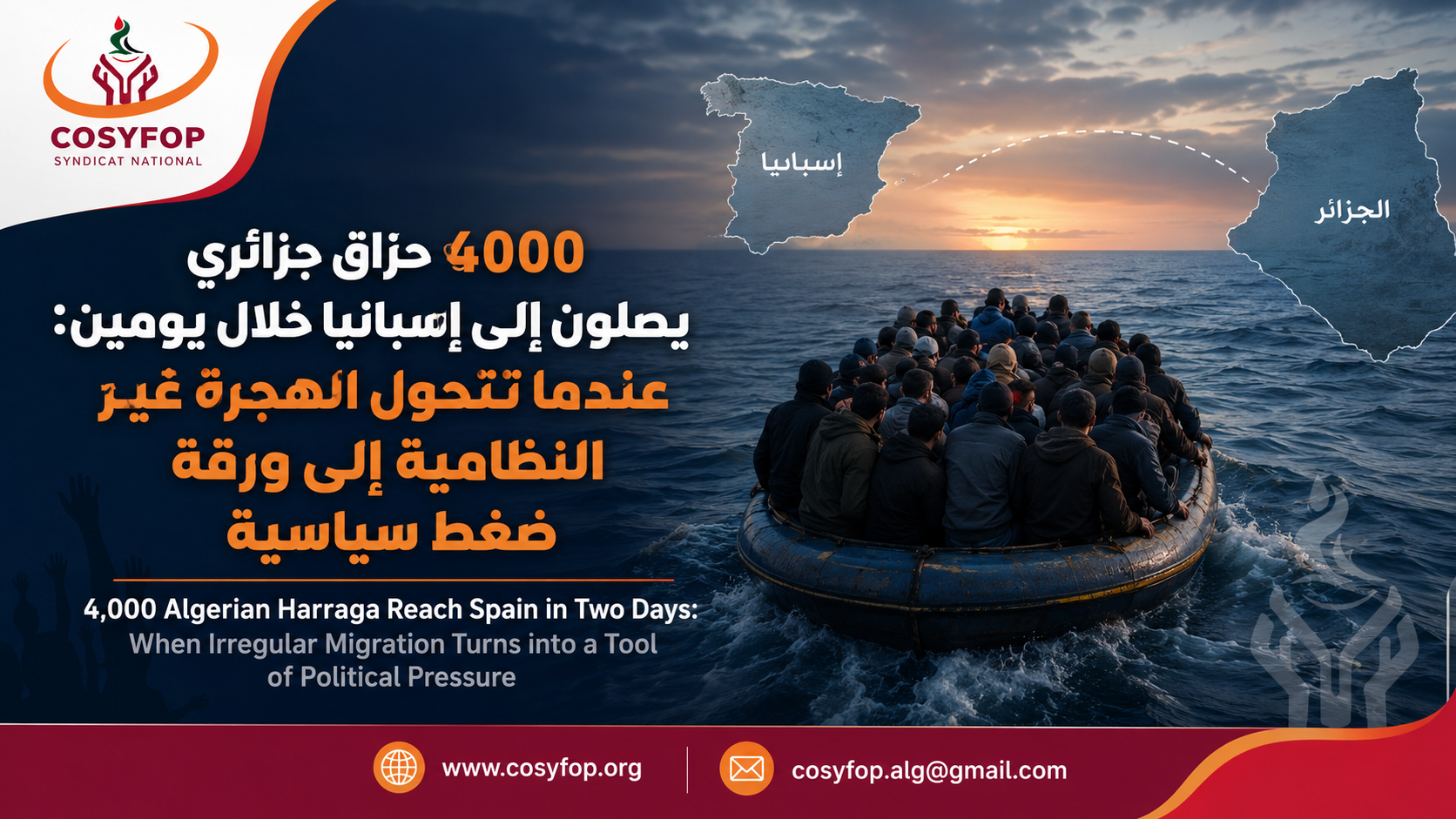
A disturbing first-hand account by a young Algerian who fled the country by sea has brought renewed attention to Algeria’s irregular migration crisis. He alleges that the boat carrying him from the coast of Annaba was allowed to depart with assistance from members of the Coast Guard. His testimony comes as recent European investigations expose highly organised smuggling networks using high-speed boats and charging migrants as much as €12,000 per person.
Taken together, these developments raise issues that go far beyond the number of boats reaching Europe. They concern how vessels are able to leave Algerian shores, the multimillion-euro criminal networks operating around them, the ability of state institutions to dismantle those networks, and the continued tendency of European policy to prioritise border security and returns over the political, economic and social conditions driving young Algerians to leave.
A 15 August 2026 edition of the television programme “Rights and Freedoms”, broadcast by North Africa TV and devoted to the situation of Algerian youth on the occasion of International Youth Day, brought the issue of harraga — the Algerian term commonly used for people attempting irregular migration, particularly by sea — back into the public debate. The discussion went beyond unemployment and social frustration to address more sensitive questions surrounding migrant-smuggling networks, the departure of high-speed boats from Algeria’s coastline, the effectiveness of maritime surveillance and allegations that some departures may benefit from facilitation by individuals within the very services responsible for controlling the coast. Participants included COSYFOP President Raouf Mellal, human rights activist Ishaq Menad, and activist Fawzi Talaa.
During the programme, Fawzi Talaa, who now lives in Paris and is the son of one of the people who disappeared during Algeria’s conflict of the 1990s and an activist with an association representing families of the disappeared, gave a first-hand account of his own irregular journey out of Algeria the previous year. He described a type of crossing commonly known among Algerian migrants as “the fast boats”, involving vessels fitted with powerful engines capable of covering the distance between the Algerian and Spanish coasts far more quickly than conventional boats. These crossings are marketed as offering a greater chance of reaching Europe safely, but at a steep price: according to Talaa, a place on such a boat can cost more than €10,000 per person.
The most serious part of his testimony concerned the circumstances in which his boat left the Algerian coast. Talaa said that, shortly before departure from Annaba, he saw the boat operator receive what he described as “telephone clearance to leave”. He further alleged that the departure was facilitated by members of the Coast Guard in Annaba. If substantiated, such claims would raise grave concerns about whether some smuggling operations are benefiting from assistance provided by individuals within agencies responsible for securing Algeria’s maritime borders.
The Trade Union Confederation of Productive Forces (COSYFOP) does not present this testimony as a judicial finding, nor does it consider one witness account sufficient to establish institutional responsibility on the part of the Coast Guard or Algeria’s security services as a whole. However, a specific allegation made publicly, on camera, by a human rights activist who personally took part in the journey cannot simply be dismissed. It warrants an independent, serious and transparent investigation to establish the facts and determine responsibility if wrongdoing is confirmed.
The testimony is all the more significant because, according to information gathered by COSYFOP, it is not an isolated account. Similar allegations have reached the Confederation, while Algerian migrants have also shared accounts on social media claiming that certain boats receive advance clearance or signals from individuals said to have links with the Coast Guard. Such accounts do not in themselves amount to proof, but their recurrence strengthens the case for proper investigation rather than allowing allegations of this nature to accumulate unanswered in the public domain.
Talaa’s account also takes on greater significance in light of recent European investigations into the increasingly sophisticated networks using high-speed boats from Algeria. Several details in his testimony — particularly the type of vessels involved, the power of their engines and the very high price charged for the journey — closely resemble patterns documented by European law-enforcement agencies investigating criminal organisations operating across both shores of the Mediterranean.
Shocking Testimony Human rights activist Fouzi Tellawa, who fled Algeria aboard so-called "death boats," accuses members of the coast guard of facilitating his departure and giving the green light for the boat to leave. Source: North Africa TV
€12,000 per person, 18 high-speed boats and more than €24 million in revenue
On 7 August 2026, just days before Talaa’s televised testimony, the Spanish Ministry of the Interior announced the dismantling of one of the largest transnational criminal networks specialising in migrant smuggling by sea across the Western Mediterranean. The operation was carried out jointly by Spain’s National Police and Civil Guard with the involvement of the EU Agency for Law Enforcement Cooperation, Europol.
Spanish authorities described the organisation as Algerian in origin and highly sophisticated in its structure, logistics and operational capacity. Investigators documented at least 64 sea crossings involving more than 2,000 migrants, generating revenues exceeding €24 million. The operation led to the arrest of 78 suspects — 77 in Spain and one in Algeria — underscoring the transnational reach of the network.
Investigators also seized 18 high-speed boats with an estimated total value of more than €5 million. Some were up to 14 metres long and fitted with three or four powerful engines. The network reportedly relied on GPS devices, satellite communications, encrypted systems and an extensive logistical infrastructure for fuel supplies, financing and the monitoring of vessel movements.
The price of these crossings is particularly striking when compared with Fawzi Talaa’s testimony. Spanish authorities said the organisation charged migrants up to €12,000 per person, while some boats carried as many as 50 passengers on a single journey. These figures make clear that this is no longer simply a matter of small groups of young people buying makeshift boats and attempting to cross the Mediterranean under cover of darkness. It is a highly profitable transnational criminal industry built around expensive vessels, powerful engines, sophisticated communications, financing and organised logistical networks.
Even more troublingly, Spanish investigators found that the network was not limited to migrant smuggling. The same vessels were allegedly used to transport synthetic drugs from Spain to Algeria, before being used on the return journey to carry migrants from the Algerian coast towards Spain. This points to a more complex criminal model in which the same maritime routes are exploited in both directions for different forms of illicit trafficking.
Who is enabling this industry inside Algeria?
It would be simplistic to argue that because Algeria possesses submarines, naval vessels and surveillance aircraft, every small or high-speed boat should automatically be detected. Maritime surveillance is more complex than that, and no security service can monitor every kilometre of coastline at every moment. The situation looks very different, however, when the activity in question is not isolated or improvised but recurrent, organised and highly profitable, involving vessels up to 14 metres long, three or four powerful engines, fuel supplies, financial networks, sophisticated communications and extensive logistical support.
An operation on that scale requires an entire supply chain: boats, engines, spare parts, fuel, maintenance, storage and movement of equipment, all of which must be obtained or brought into Algeria despite significant import restrictions. It also involves the collection and transfer of substantial sums in euros outside the formal banking system, making the informal foreign-exchange market and other financial channels relevant to any serious investigation into how these networks are funded.
Assessing the effectiveness of the Algerian security and judicial response therefore requires much more than figures on intercepted migrants. It requires transparency about how many high-speed boats and powerful engines have been seized, how many organised networks have been dismantled, how many organisers and financiers have been prosecuted, and whether investigations have examined the possible involvement of public officials, security personnel or Coast Guard officers in providing information, protection or facilitation.
These are not allegations that can simply be treated as established fact. They are issues arising directly from the scale, organisation and profitability of the activity, and they have become more pressing following Talaa’s public testimony and the evidence uncovered by Spanish investigators about organised high-speed smuggling operations linking Algeria and Spain.
The authorities publish interception figures ... but the wider picture remains unclear
It is important to correct the impression that Algerian authorities say nothing about irregular migration. The Ministry of National Defence regularly publishes figures on Coast Guard operations. In a statement issued on 22 July 2026 , the ministry said Coast Guard units had thwarted irregular migration attempts and rescued 618 people travelling in hand-built boats.
These figures are useful, but they provide only a partial picture. Knowing how many people were intercepted or rescued at sea says little about the structure of the networks behind the crossings, the types of vessels being used, the power of their engines, the main departure points or the financial and logistical infrastructure sustaining the trade.
The changing nature of harraga makes such information increasingly important. What was once associated mainly with improvised boats and relatively small-scale departures now includes high-speed vessels, powerful engines and transnational networks involving financing, communications and transport logistics. Measuring the effectiveness of state action therefore requires information on seized boats and engines, dismantled networks, prosecutions of organisers, financiers and intermediaries, and the value of assets and equipment confiscated.
Without a consolidated national picture, it is difficult to assess whether enforcement efforts are targeting the criminal infrastructure itself or mainly the most vulnerable link in the chain — the young people intercepted at sea. Transparency about investigations into possible facilitation by public officials or personnel responsible for coastal surveillance is equally important in light of the allegations now circulating and the sophistication of the networks documented by European investigators.
Publishing interception and rescue figures is therefore necessary, but it is not enough. Public confidence requires a regular and comprehensive national assessment covering intercepted migrants, dismantled networks, seized vessels and equipment, financial routes and the outcome of judicial investigations into the organisation or facilitation of these operations.
Algeria has become a major departure point on the Western Mediterranean route
During the first five months of 2026 Frontex recorded a decline of around 40% in detections of irregular crossings at the European Union’s external borders. The downward trend continued during the first half of the year, with an overall fall of roughly 37%. The Western Mediterranean route, however, stood out as a major exception, continuing to rise, with Frontex linking the increase primarily to departures from Algeria.
During the first ten months of 2025, Frontex reported that more than 75% of migrants using the Western Mediterranean route had departed from Algeria. The significance of this trend becomes even clearer when compared with the previous year. During the first ten months of 2025 , Frontex reported that more than 75% of migrants using the Western Mediterranean route had departed from Algeria. The agency subsequently continued to identify Algeria as the main driver of migration along this route, suggesting that the increase seen in 2026 is not a short-lived fluctuation but the continuation of a trend already established in 2025.
Council of the European Union data further illustrate Algeria’s growing weight on this route. By the end of April 2026, Algerians were the largest nationality recorded on the Western Mediterranean route, with around 1,981 people, while irregular arrivals across the western routes as a whole stood at close to 8,000.
The figures point to a significant geographical shift in migration pressure towards Europe. While flows have fallen on several other routes, departures linked to Algeria have continued to rise, at the same time as smuggling operations have evolved into increasingly sophisticated criminal structures. Migration from Algeria therefore requires an approach that goes beyond border enforcement to examine its domestic causes, financing, logistics and the ability of both Algerian and European institutions to dismantle the networks profiting from it.
Harraga is not merely a border issue ... it is a crisis of governance and trust
Irregular migration is not fundamentally a border problem. It is the outcome of accumulated economic, social and political failures that have led a growing number of young Algerians to lose confidence in their ability to build a future at home. A young person does not simply wake up one morning and become a harrag. The decision to risk a sea crossing is often preceded by years of unemployment, bureaucracy, difficulty achieving economic and social independence, limited professional prospects and a sense of having little influence over public and political life.
According to International Labour Organization estimates published through the World Bank, unemployment among Algerians aged 15 to 24 reached 29.4% in 2025. Among young women, the rate stood at 45%, compared with 26.5% among young men.
The problem cannot be explained by a lack of education or qualifications alone. World Bank data show that women account for more than half of Algeria’s graduates in science, technology, engineering and mathematics, even as unemployment among young women remains exceptionally high. The disconnect between educational achievement and access to stable employment contributes to the perception that qualifications and hard work no longer guarantee economic independence.
Yet economic explanations alone are insufficient. The crisis is also about whether young people feel they have a meaningful place in public life and access to peaceful channels through which they can organise, express themselves and influence policies affecting their future. Following his official visit to Algeria, the UN Special Rapporteur on the rights to freedom of peaceful assembly and of associationhighlighted restrictions and practices affecting the ability of civil society organisations and activists to organise and operate freely. Political and civic participation therefore forms an essential part of the broader crisis of confidence.
When unemployment is combined with delayed social independence and shrinking space for participation, frustration becomes more than an individual problem; it develops into a loss of faith in the future. For some young people, migration is no longer simply about earning more abroad. It becomes a way out of a situation they no longer believe they can change from within. Primary responsibility rests with the authorities, which control the state budget, administration, economic and employment policy, security institutions and legislation, and therefore possess the principal tools required to alter the conditions producing this frustration.
At the same time, Algeria’s opposition cannot be entirely absolved of political responsibility, although its responsibility cannot be equated with that of the government. Much of the opposition has struggled to build broad organisations capable of reaching younger generations, channelling their frustration into sustained civic and political participation, and offering a credible alternative that makes change appear achievable rather than remote.
The youth crisis is not only about jobs ... it is also about the right to organise
Reducing Algeria’s youth crisis to unemployment addresses only part of the problem. Under the ILO’s own principles, decent work is inseparable from freedom of association, social dialogue and the collective ability of workers to defend their interests. Training and employment programmes will therefore remain limited if young people are not also given genuine space to organise, participate and express their demands lawfully and peacefully.
This contradiction is particularly visible in Algeria. While the European Union finances and the ILO implements the Y-NEET programme to support young people who are not in employment, education or training, with activities involving ministries, employment bodies and government institutions, the ILO’s own supervisory mechanisms continue to record concerns and restrictions affecting freedom of association. These include Case No. 3434, concerning COSYFOP’s complaint against the Algerian government, while the Committee of Experts has continued to raise concerns about legislation governing trade union rights and strikes.
The European Union itself acknowledges these difficulties. Its 2025 report on human rights and democracy referred to judicial proceedings and imprisonment affecting trade union officials in Algeria. European and international institutions funding youth programmes are therefore already in possession of official information documenting the obstacles facing independent trade union activity.
This matters because a young person who is unemployed and at the same time lacks access to an independent trade union, association or civic organisation capable of representing collective demands is more likely to seek individual solutions. Addressing youth vulnerability should therefore involve more than funding technical employment programmes or strengthening public administrations. Independent trade unions, civil society organisations and genuine representatives of young people should be involved in the design, implementation and evaluation of such programmes.
The right to organise is not separate from employment or migration policy. When young people are able to organise, negotiate and defend their interests peacefully, collective action becomes a credible alternative to the individual search for escape. Supporting independent unions and civil society should therefore be an integral part of any serious European or international strategy aimed at addressing the causes of migration from Algeria.
To the European Union: do not reduce Algeria’s youth to a security file
Algerian migration has become increasingly prominent in European debates over returns, readmission and border control. In the first quarter of 2026, Algerians were the largest nationality among people ordered to leave EU member states, accounting for more than 11,000 people — over 10% of all orders to leave issued during the period.
Treating this reality simply as a question of how many people can be returned, or the extent of Algeria’s cooperation on readmission, risks reducing a complex social, humanitarian and political issue to an administrative and security exercise. This approach can also be seen in European political debates that connect cooperation with Algeria to readmission, visas, funding and bilateral relations. When migration is handled primarily through these bargaining mechanisms, vulnerable Algerian migrants risk becoming part of an intergovernmental negotiating equation rather than being treated first and foremost as rights-holders. Combating smuggling networks is a legitimate responsibility of states; using migrants themselves as political or diplomatic leverage is a different matter.
The contradiction is particularly striking because the European Union itself states, through its Pact for the Mediterranean and its policies on the Western Mediterranean route, that partnership with southern Mediterranean countries should include opportunities for young people, legal mobility, education, employment and rights protection alongside migration management. The credibility of those commitments should therefore be judged by their implementation, not simply by Europe’s ability to reduce arrivals at its borders.
European cooperation with Algeria on migration and development should also be assessed against clearer standards of transparency and impact. Funding should not be measured only by the number of training schemes or government programmes announced, but by whether those programmes genuinely reach young people and help create an environment in which independent participation, association and peaceful defence of interests are possible. In that context, the meaningful involvement of independent trade unions and credible civil society organisations in the design, monitoring and evaluation of programmes is essential rather than optional.
An effective European approach cannot begin only when a boat reaches the Spanish or French coast. It must also examine the impact of European policies on the southern shore of the Mediterranean. Investment in genuine stability requires support for an environment in which citizens can organise, speak out and claim their rights peacefully, alongside scrutiny of how public assistance is used. Governments should not be treated as the only legitimate partners in addressing youth and migration.
Success in EU-Algeria cooperation should therefore not be measured solely by the number of returns carried out or security agreements concluded. It should also be measured by whether that cooperation helps reduce the pressures pushing young people to seek a future abroad and whether it respects the rights on which the Euro-Mediterranean partnership claims to be based. Mediterranean security will not be achieved simply by stopping boats from arriving; it will be achieved when fewer young people see an irregular sea crossing as a more realistic option than building a future at home.
COSYFOP calls for an independent and transparent investigation
In light of Fawzi Talaa’s testimony and the evidence uncovered by Spanish investigators, the Trade Union Confederation of Productive Forces (COSYFOP) calls for an independent and transparent investigation into the networks organising irregular migration by high-speed boat, covering the sourcing of vessels and engines, fuel supplies, financing and departure points, as well as any allegation that public officials or personnel responsible for coastal surveillance may have provided information, protection or facilitation.
COSYFOP also calls on Algeria’s Ministries of National Defence and Interior to publish regular and detailed national data on seized boats and engines, dismantled networks, prosecutions, financial routes and the outcome of investigations involving suspected corruption or complicity within state institutions, while ensuring that witnesses and their families are protected from intimidation or retaliation.
The Confederation further urges the European Union and the countries most directly concerned by the Western Mediterranean route, particularly Spain and France, to make transparency, respect for rights and freedoms, freedom of association and the participation of independent trade unions and civil society part of their cooperation with Algeria on migration and youth, rather than limiting that cooperation to border control, returns and readmission.
At the same time, COSYFOP calls on independent Algerian civil society organisations, independent trade unions, Algerian and international human rights organisations, research centres and experts working on migration and human rights to move this issue beyond isolated news reports and develop sustained documentation and analysis, including the collection and verification of testimonies and closer scrutiny of the financial, logistical and human-rights dimensions of irregular migration.
These organisations should also bring the available evidence and analysis directly to European institutions, particularly the European Commission, the European Parliament and the European External Action Service, and ensure that the issue becomes part of the wider debate on EU-Algeria relations and migration policy in the Western Mediterranean. Leaving the subject almost entirely within government-to-government security arrangements risks excluding independent scrutiny and meaningful civic accountability.
For COSYFOP, Fawzi Talaa’s testimony, now given publicly and documented on television, should mark the beginning of wider documentation, investigation and civil-society pressure — not simply become another testimony forgotten once the broadcast is over.
Participation by the President of the Trade Union Confederation of Productive Forces (COSYFOP) in the programme “Rights and Freedoms” on North Africa TV, alongside political activist Ishaq Menad and human rights activist Fawzi Talaa. The discussion focused on unemployment, irregular migration (harraga) and the future of Algerian youth. During the programme, human rights activist Fawzi Talaa gave a disturbing first-hand account alleging that members of the Algerian Coast Guard facilitated the departure of the boat on which he left the country. Source: North Africa TV
📬 Did you like this article? Subscribe to our newsletter to receive the latest news and important information directly to your inbox.