🗓️Published on: 14/11/2026
In the weeks when hundreds of thousands of workers, school pupils and students took to the streets of Paris, Madrid, Brussels and Geneva to defend wages, housing and public services, Algerians were sharing photos of empty shelves and of prices well above the official ceiling. By then the potato crisis in Algeria had become a daily symbol of shrinking purchasing power, and reports of disrupted cooking oil supplies were coming in from several provinces. Yet the gulf between the two scenes runs deeper than the scale of the crises. In Europe, for all the tensions and excesses, workers have unions that negotiate, strike and march, and governments that sooner or later have to sit down with them, whereas independent unions in Algeria operate under legal restrictions and practices that the International Labour Organization's supervisory bodies have documented time and again. That contrast is the starting point of this article, in which the Trade Union Confederation of Productive Forces (COSYFOP) declares its solidarity with Europe's social movements and asks what lessons their experience holds for Algeria.
Europe's autumn 2026 strike wave over wages, housing and public services
These are not isolated protests but a broader social wave, in which demands over wages and the cost of living converge with opposition to the austerity built into the 2027 budgets. Its forms nonetheless vary, from a nationwide general strike in Spain to successive days of strikes and national demonstrations in France and Belgium, and to public-sector and subsidised-sector strikes in several Swiss cantons. Any careful analysis must also separate what has actually happened from what has been announced but has not yet taken place, a distinction we keep to in each of the cases below.
France, from school blockades to the 5 November strike
The first spark came from France's secondary schools, where a pupils' movement began on 21 September 2026 to demand replacements for absent teachers and more resources for schools. University students joined in early October, and clashes in several major cities led the Prime Minister to convene a crisis unit. The Interior Ministry reported nearly 2,000 arrests on 1 October alone and the government described part of the unrest as “urban violence”, a reminder that European governments, too, readily fall back on a security response when protests spread.
Meanwhile, the unions mobilised against the draft 2027 budget, which freezes the index point that sets civil servants' pay for yet another year and seeks spending cuts worth tens of billions of euros. After a large public-sector day of action on 29 September came the cross-industry strike of 5 November, called jointly by the CFDT, CGT, FO, UNSA and FSU and joined by school and student organisations, and that day's demonstrations proved one of the broadest mobilisations since the movement began. The Interior Ministry counted 575,000 demonstrators at 193 events, including 65,000 in Paris, and the unions, as is customary, put the figures much higher.
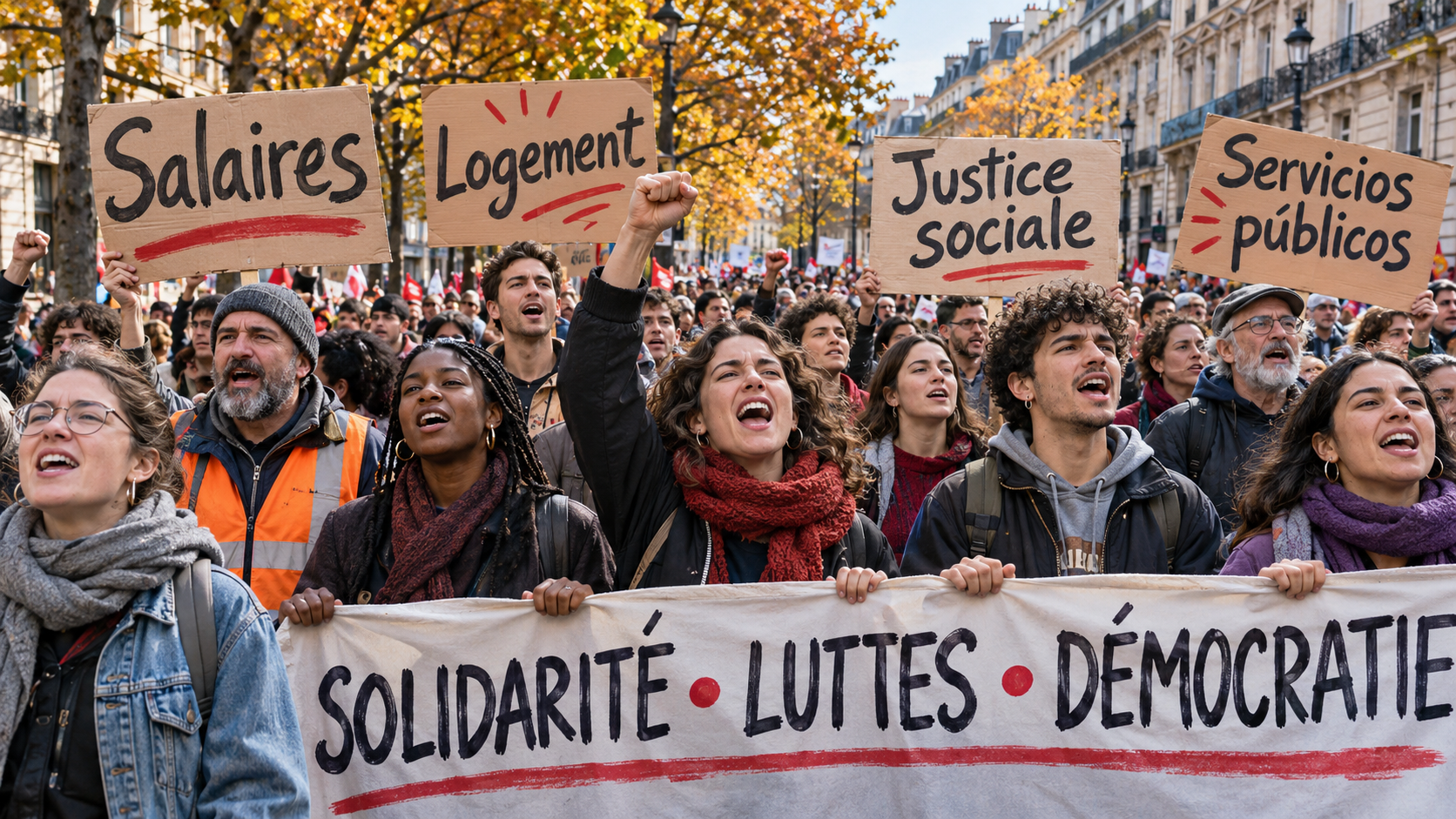
The government responded on two parallel tracks, deploying 70,000 police officers and gendarmes to oversee the 5 November marches while opening a negotiating channel, as Prime Minister Sébastien Lecornu convened a social conference at Matignon on 9 November that ended with the announcement of a 1.6% increase in the national minimum wage (SMIC) from 1 December. The unions, however, judged the increase insufficientand the CGT and the coordination of public-sector unions called a new strike day for 17 November. All this is unfolding in a country preparing for a presidential election in spring 2027, whose government is trying to pass its budget through a parliament in which it lacks an absolute majority.
Spain's first general strike in fourteen years, in defence of the right to housing
Spain's housing crisis became a national issue in September 2026, when the eviction of an 87-year-old woman from her Madrid home sparked a wave of protests and sit-ins led by the Tenants' Union in the Puerta del Sol that soon spread to dozens of cities. Anger grew further when the Congress of Deputies rejected the government's housing decrees, in a political sequence that ended with a snap general election being called for 29 November. On 7 October, Comisiones Obreras (CCOO) and the General Union of Workers (UGT) agreed with the confederation of tenants' unions and other organisations, including the CGT and the CNT, to call a 24-hour general strike for Wednesday 11 November. The strike was formally registered with the Labour Ministry on 19 October under the slogan “Wages, housing, prices” and was the first general strike since 2012 to be backed jointly by Spain's two largest unions.
On 11 November, mass marches in the major cities were hailed as a success by the unions, which nonetheless acknowledged uneven participation in the strike, from around 75% in Andalusia and Aragon to around 41% in Extremadura and Castilla-La Mancha. The Barcelona march ended in rioting, police used force against some picket lines in Madrid and dozens of people were arrested, prompting the unions to threaten legal action over what they called “disproportionate” interventions. The Spanish case also stands apart because the strike did not target a specific government austerity plan, the unions having stressed that it was aimed at the public authorities responsible for housing at every level and at employers' organisations, in a country where the right to housing has become the centrepiece of the election campaign.
Belgium's unions keep up the pressure on the “Arizona” coalition
For more than a year and a half, the “Arizona” coalition led by Prime Minister Bart De Wever has faced continuous union mobilisation in Belgium against reforms to pensions, unemployment benefits and the automatic indexation of wages to prices, as the government seeks €10 billion before the end of its term in 2029. On 9 October 2026, between 30,000 and 50,000 demonstrators , according to police and union estimates, marched through Brussels at the call of the General Labour Federation of Belgium (FGTB) and with the support of the Confederation of Christian Trade Unions (CSC). The march was marred by violence on its fringes, coincided with large protests in French-speaking education and was followed by a public services strike on 12 October.
The FGTB had threatened a general strike in the week beginning 23 November if the government pressed ahead unilaterally with changes to wage indexation, a VAT increase or the annualisation of working time. What the three unions (the FGTB, the CSC and the liberal union Synova) actually announced on 21 October, however, was a new national demonstration in Brussels on 23 November, open to mutual health insurers, anti-poverty associations, youth organisations and environmental movements. It is backed by a €21 billion alternative budget built on tax justice, the fight against fraud and a fairer contribution from capital income, and at the time of writing it had been announced but had not yet taken place.
Switzerland, Geneva and Vaud push back against budget cuts
In Switzerland, where much of social policy and public services is run at cantonal level, Geneva's state employees and subsidised-sector staff have been mobilising since November 2025 against austerity measures ranging from frozen annual pay steps and the absence of cost-of-living indexation to higher contributions to the state employees' pension fund. The canton's finances are in an exceptional situation, as it has had to operate throughout 2026 on a provisional budget after the cantonal parliament rejected two successive budget bills. The Cartel intersyndical, the joint body of unions representing state and subsidised-sector staff, responded to the 2027 draft budget (a deficit of more than CHF 546 million and cuts of nearly CHF 250 million) with a new demonstration on 1 October, which drew around 600 people and where a half-day strike was announced for 26 November. A coalition of unions and progressive forces is also preparing a major demonstration for the same month.
In neighbouring Vaud, between 6,000 and 8,000 people according to the police, and more than 15,000 according to the organisers marched through Lausanne on 5 November 2026 at the call of the three public-sector unions. They demanded the withdrawal of the 2027 budget cuts, which grew by a further CHF 100 million after voters approved a tax initiative known as the “12% initiative” on 27 September, ahead of the cantonal parliament's budget debate due to begin on 1 December.
What these movements share and where they differ
Different as their countries are, these movements converge on three main points. The first is the widening gap between wages and the cost of living, whether it shows up in housing in Spain, in frozen public-sector pay in France and Geneva or in the erosion of wage indexation in Belgium. The second is the refusal to make workers and public services bear the cost of restoring public finances, and the third is the striking presence of young people and social movements alongside the unions, from French secondary school pupils to Spanish tenants' unions and Belgian associations. Yet these common threads do not erase the differences, for the Spanish government is not the one imposing austerity, the French movement is unfolding in the year before a presidential election and with a divided parliament, and the Belgian conflict revolves around structural reforms championed by a coalition that refuses to back down, whereas Switzerland's disputes play out within cantonal budgets subject to direct democracy.
For Algerian readers, the most important point is that these movements, however heated and despite the controversial police interventions that sometimes accompanied them, took place within legal frameworks that recognise the right to strike and to demonstrate. In more than one country they led to negotiations, as with France's social conference, or carried the conflict into parliaments and the ballot box, as in Spain and Switzerland.
Algerian trade union solidarity across borders
Through this article, the Trade Union Confederation of Productive Forces expresses its full solidarity with the workers, public employees, school pupils, students and tenants, and with the trade unions leading these movements in France, Spain, Belgium and Switzerland. Their demands for wages that guarantee dignity, affordable housing and decent public services are the very demands Algerian workers are raising in far harsher conditions. The Confederation believes that cross-border workers' solidarity is neither a luxury nor a courtesy, because the pressures weighing on workers are much the same on both shores of the Mediterranean, from inflation to the decline of public services. Trade union freedoms are, moreover, universal and indivisible rights, enshrined in the International Labour Organization's Freedom of Association and Protection of the Right to Organise Convention (No. 87) and its Right to Organise and Collective Bargaining Convention (No. 98), both of which Algeria ratified in 1962.
The Confederation stresses that defending the freedom to organise, to strike and to demonstrate peacefully admits no double standards, which is why it rejects the disproportionate use of force against protesters wherever it occurs, in Paris, Madrid or Brussels as much as in Algeria. In its view, Europe's social demands reopen a fundamental question about governments' responsibility to protect economic and social rights and about their duty to engage with independent unions rather than simply manage public anger through policing. It also calls on the European trade unions now fighting their own social battles to place the situation of Algerian trade unionists among their solidarity priorities, because genuine solidarity is a two-way street.
What the potato crisis in Algeria and the cooking oil shortages reveal about purchasing power
Potatoes, caught between a price cap and empty shelves
Potato prices rose steadily from late summer 2026, prompting the Ministry of Domestic Trade and National Market Regulation to issue an instruction dated 1 October 2026after an inter-ministerial meeting and an agreement with representatives of the agricultural value chains, farmers and cold-storage operators. The instruction set the retail price at between 80 and 90 dinars per kilogram and required inspection services to report daily to the central administration on compliance. Yet the cap changed the shape of the crisis rather than ending it, with the consumer protection organisation Himayatek first criticising the sale of poor-quality potatoes at the capped price before the problem shifted, in early November, from high prices to scarcity. Shortages were reported in a number of markets in Algiers, in the east of Bouira province and in other provinces, and where potatoes could still be found they sold for 110 to 140 dinars per kilogram, as much as 50 dinars above the official ceiling.
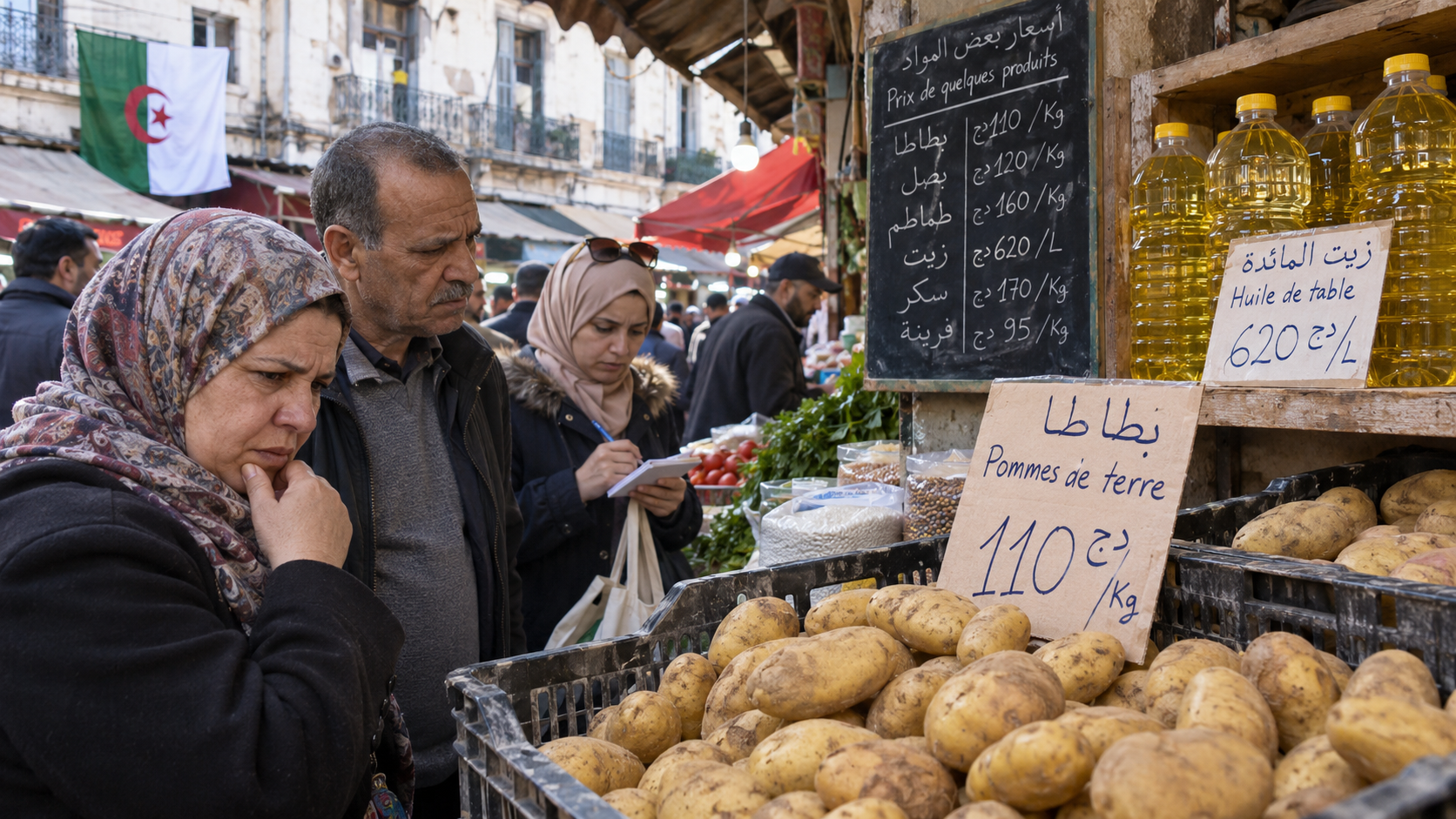
It is worth separating established facts from the explanations in circulation, for while it is clear that prices rose, that the authorities resorted to a price cap and that shortages then appeared in several provinces, the causes remain disputed. One reading blames some wholesalers for refusing to sell on the imposed terms (an account relayed by the press from the markets without official confirmation), whereas economists cited in a BBC Arabic reportpoint to weak production, transport and storage problems and the many intermediaries in fresh produce supply chains. Nor is this the first time potatoes have dominated the headlines, as the President of the Republic himself acknowledged in April 2025 that a kilogram had reached 150 to 160 dinars, and similar crises in previous years make it hard to accept that this is merely a passing problem.
Cooking oil, a recurring crisis between official denials and consumer complaints
Between spring 2021 and early 2022, Algeria went through successive shortages of subsidised cooking oil, with queues outside shops and recriminations between producers, traders and the administration. The official line wavered between denying any shortage andblaming speculation, hoarding and fake news, until a parliamentary committee identified twenty causes of the crisis, chief among them the refusal to use invoices and failures in distribution. In the same vein, the authorities adopted Law No. 21-15 of 28 December 2021 on combating illicit speculation, published in Official Gazette No. 99 of 29 December 2021, which toughened penalties for speculators, a punitive approach that has not prevented recurring disruptions in other staple goods.
In November 2026 the picture is murkier, as press reports say cooking oil has been scarce for more than two weeks in several provinces, including Algiers, Bouira, Oran, Tlemcen, Relizane and Sétif, and quote an unnamed industry source as saying that the Cevital complex in Béjaïa was running at around half capacity because of maintenance problems. The leading producers, Cevital among them, deniedany disruption to production or distribution and insisted that their plants were operating normally. Cooking oil, it should be noted, is a subsidised product sold at regulated prices of 125 dinars a litre, 250 dinars for a two-litre bottle and 650 dinars for a five-litre bottle. In the absence of up-to-date official figures, it is impossible to say for certain that there is a nationwide cooking oil crisis. Yet repeated complaints from provinces far apart, together with a meeting held by the Ministry of Domestic Trade with producers on 26 October to review strategic reserves and production capacity ahead of Ramadan, show that supply remains fragile.
What official speeches leave out about wages, inflation and unemployment
The authorities point to a positive social record, noting that the Council of Ministers raised the guaranteed national minimum wage from 20,000 to 24,000 dinars from January 2026 and the unemployment allowance from 15,000 to 18,000 dinars. On 4 October 2026, the Council also approved the draft finance bill for 2027 , which provides for further pay rises, and the President of the Republic has renewed his pledge to complete a 53% wage increase. In the Confederation's view, however, these increases are decided unilaterally, outside any genuine collective bargaining with independent unions, and they mainly concern public-sector employees, as private-sector workers do not benefit from them directlyeven though they make up a large share of the workforce.
The indicators paint a less reassuring picture, as data from the National Office of Statistics show that prices in August 2026 were 8.01% higher than in August 2025. At the end of its 2026 Article IV consultation, the International Monetary Fund noted that inflation had gone from minus 2% in September 2025 to 5.2% in April 2026 and expected it to rise temporarily during 2026, warning of a budget deficit that reached 10.5% of GDP in 2025 and of continued recourse to monetary financing. Unemployment figures raise just as many questions, because the National Office of Statistics announced a rate of 12.7% for October 2024 and then, about a week later, revised it to 9.7% , citing adjustments for informal work and jobs created at the end of the year. Such a revision raises legitimate doubts about the reliability of the figures on which public policy is built.
Faced with this gap between rhetoric and reality, the Confederation published its study on purchasing power in Algeriaon 20 September 2026, based on a field survey carried out on 14 September in several provinces. The study found that the prices of 17 of 18 comparable products exceeded the average administered price, that merely restoring 2021 purchasing power would require a minimum wage of around 27,000 dinars gross, and that a worker living alone with no housing payments needs a monthly budget of close to 35,000 dinars. On that basis, the Confederation launched a petition calling for the guaranteed national minimum wage to be raised to 35,000 dinars as a first step from 2027, with signatures open until 25 December 2026, and it is demanding that this measure form part of a genuine and comprehensive social dialogue with the unions.
Read in this context, the potato crisis in Algeria and the cooking oil disruptions show that the problem lies not in any single commodity but in an entire model of market management built on price caps, the criminalisation of speculation and the release of stocks in emergencies. That model leaves the underlying failures in production, storage and distribution untouched, and it offers neither transparent data nor any real involvement of producers, consumers and unions in shaping solutions. When basic goods swallow an ever larger share of wages that were already low, every supply crisis becomes a daily test of households' patience and a sign of a social fragility that reaches beyond the market and erodes trust in institutions.
What international supervisory bodies say about trade union freedoms and the security approach in Algeria
Laws 23-02 and 23-08 under the scrutiny of the Committee of Experts
The current legal framework rests on two texts adopted in 2023, namely Law No. 23-02 of 25 April 2023 on the exercise of trade union rights, published in Official Gazette No. 29 of 2 May 2023, which repealed Law No. 90-14, and Law No. 23-08 of 21 June 2023 on the prevention and settlement of collective labour disputes and the exercise of the right to strike, published in Official Gazette No. 42 of 25 June 2023. The government presented both texts as a reform in line with international standards, yet the Committee of Experts on the Application of Conventions and Recommendations, in an observation published in its report to the 113th Session of the International Labour Conference in 2025, urged it to review Articles 12 to 15 of Law No. 23-02, which impose a general ban on trade unions' political activity, as well as Articles 37 to 42 on union statutes. The Committee also asked for Articles 49 and 56 of the same law to be amended and for Article 61 to be repealed, and it called for the lifting of the excessive restrictions on the right to strike contained in Articles 42 and 45 of Law No. 23-08. It further sought shorter prior settlement procedures, which can take more than sixty working days before a lawful strike can be called, a period it considered liable to make strikes difficult or even impossible.
The Committee of Experts also expressed the expectation that the government would resolve without further delay the registration of the Trade Union Confederation of Productive Forces, the Autonomous General Confederation of Workers in Algeria (CGATA) and other trade union organisations, having noted that the Confederation's communication contained numerous allegations of harassment of its leaders and members. In June 2024, the Conference Committee on the Application of Standards of the International Labour Conference examined Algeria's case under Convention No. 98. In its conclusions, it asked the government to strengthen cooperation with independent social partners, to adopt legislation providing effective protection against anti-union discrimination with sufficiently dissuasive sanctions, to guarantee the right of minority unions to bargain at least on behalf of their own members and to review trade union registration procedures. Along the same lines, the United Nations Special Rapporteur on the rights to freedom of peaceful assembly and of association concluded in the report on the visit to Algeria , published in May 2024, that the criminalisation of civil society work had had a chilling effect and created a climate of fear.
The Committee on Freedom of Association deeply regrets the absence of any government initiative
The most recent and clearest recommendations come from the Committee on Freedom of Association, whose 415th Reportwas approved by the ILO Governing Body on 13 June 2026. It examined Case No. 3434, the complaint lodged by the Trade Union Confederation of Productive Forces with the support of Public Services International (PSI) and the International Union of Food, Agricultural, Hotel, Restaurant, Catering, Tobacco and Allied Workers' Associations (IUF). The Committee noted “with deep regret” that the government had not reported any concrete initiative to resolve the registration and recognition of the Confederation, urged it to take a proactive approach by entering into discussions with the Confederation's representatives without delay, and expected it to take the necessary measures immediately to give them free access to premises for their trade union meetings. It also expected the international travel bans imposed on trade unionists to be lifted as soon as the ongoing investigations were concluded, and it said it remained “deeply concerned” by the allegations of repressive acts targeting the leaders of the Confederation and its affiliated organisations. Finally, it stated that it “strongly deplores” the government's failure to take any specific action to follow up on its earlier recommendations calling for dialogue with the Confederation, despite the seriousness of the situation.
The Confederation is not alone in facing such measures, for on 28 July 2026 a court ruling dissolved CNAPESTE (the National Autonomous Council of Teaching Staff of the Three-Cycle Education Sector) at the request of the Ministry of Labour, supported by the Ministry of National Education and based on Law No. 23-02, according to the union's legal representatives. Amnesty International described the ruling as “a devastating blow to independent trade union activity in Algeria”. In an earlier article, the Confederation drew attention to the gap between the text of Law No. 23-02 and its application in practice, with independent unions dissolved for alleged non-compliance while a documented case of a party office held alongside a union post in another organisation has gone unchallenged.
When the channels of dialogue are closed
Taken together, these facts outline an approach to independent trade unionism dominated by security and administrative measures, from refusals to register unions, the denial of premises, travel bans and prosecutions to the dissolution of unions by court order, while the major decisions on wages and prices are taken unilaterally. The danger of this approach is that it treats symptoms rather than causes, for capping the price of potatoes by administrative instruction or criminalising speculation through a punitive law cannot make up for the absence of regular dialogue with producers, traders, consumers and unions, who are best placed to diagnose market failures. Shutting independent unions out of negotiations, moreover, deprives the authorities themselves of intermediaries capable of turning anger into demands that can be discussed and settled.
Speaking from a sense of responsibility rather than alarmism, the Confederation warns that mounting pressure on purchasing power, combined with the continued closure of channels for organised expression and collective bargaining, is likely to deepen the sense of injustice and marginalisation and to raise social tensions. It could also push people towards spontaneous and unstructured forms of protest whose outcome would be hard to control, a possibility whose timing and scale no one can predict but which remains real as long as its causes persist. Recent experience in Europe shows that strong, recognised unions do not weaken the state but give it counterparts able to negotiate and to honour what has been agreed, even at the most tense moments.
The Confederation's call for social dialogue before it is too late
In light of these facts, the Trade Union Confederation of Productive Forces renews its call on the Algerian authorities to change radically the way they handle social issues, and sums up its demands in five points.
- 1. Respecting trade union freedoms and the fundamental rights of workers, first and foremost the freedom to organise, to strike and to demonstrate peacefully, and implementing the recommendations of the ILO supervisory bodies without selectivity, including by resolving the registration of independent unions and revising Laws 23-02 and 23-08 in consultation with trade union organisations.
- 2. Establishing a genuine and regular social dialogue with independent trade unions covering wages, prices and social policy, instead of unilateral decisions announced without negotiation.
- 3. Reviewing the security approach to peaceful social demands, lifting the travel bans imposed on trade unionists and ending prosecutions linked to legitimate trade union activity.
- 4. Tackling the causes of social and economic anger rather than merely managing its consequences, through a fair wage policy, transparent statistics and reform of the production, storage and distribution chains for staple goods.
- 5. Opening up democratic space and broadening the participation of trade unions and civil society in shaping and evaluating public policy.
What is happening today in Paris, Madrid, Brussels, Geneva and Lausanne is a reminder of a simple truth, namely that social crises do not disappear when people are prevented from voicing them but find their way onto the streets, into the ballot box or to the negotiating table. The governments best able to overcome them are those willing to sit down with workers' representatives before confrontation is forced upon them. If the potato crisis in Algeria has exposed the limits of managing markets by decree, the moment calls for a shift from a logic of control and surveillance to one of dialogue and partnership. Algerian workers are not asking for privileges but claiming their right to a wage that allows them to live in dignity, and to free trade unions able to defend them without fear. In that spirit, the Trade Union Confederation of Productive Forces remains ready, as the Committee on Freedom of Association itself has recorded, to enter into unconditional dialogue on implementing the recommendations of the international supervisory bodies, true to its mission of defending workers in Algeria and standing in solidarity with workers wherever they may be.
The information in this article is current as of 13 November 2026.
COSYFOP | News Report
From Protests in Europe to the Cost-of-Living Crisis in Algeria
Watch the Trade Union Confederation of Productive Forces (COSYFOP) video report on the social protests that swept across Europe in autumn 2026, the purchasing power crisis in Algeria, and the #مانيش_راضي (I'm Not Satisfied) social media campaign.
▶ Watch the Report on YouTube📬 Did you like this article? Subscribe to our newsletter to receive the latest news and important information directly to your inbox.