🗓️ Published on: 16/12/2025
At a moment when trade union activity in Algeria is facing unprecedented pressure, the solidarity statement issued by the French SUD-Rail trade union federation has reopened fundamental questions about the state of the labor movement — not only in relation to state repression, but also regarding the silence and complicity within the official union itself, the General Union of Algerian Workers (UGTA).
SUD-Rail is one of the trade union federations affiliated with France’s Solidaires union confederation. It brings together railway and transport workers’ unions and is widely recognized for its outspoken defense of trade union freedoms and its active involvement in international labor solidarity networks—particularly in support of independent unions operating under repressive conditions.
In its statement, the federation expressed explicit solidarity with railway workers and trade unionists in Algeria, drawing attention to the arrest and detention of more than ten union leaders at the National Railway Transport Company (SNTF). Among those targeted is Mohamed Djebrani, Secretary-General of the Railway Workers’ Federation.
According to the statement, these arrests followed a limited and entirely legitimate professional action whose sole purpose was to defend basic workplace demands. That action was met instead with repression, criminalization, and ready-made accusations invoking so-called “state security.”

The true scandal is not repression alone, but the UGTA’s silence
Yet the deeper—and far more dangerous—scandal lies not only in the repression exercised by the authorities against trade unionists affiliated with the UGTA, but in the UGTA’s own total silence.
This union, which is supposed to serve as the natural framework for defending its activists, has issued no statement, provided no clarification, and has not even taken the minimal step of posting a single message on its Facebook page to inform public opinion that its own union leaders are behind bars.
How can an organization that claims to represent workers remain silent while the secretary-general of a key federation is imprisoned? And what credibility can a trade union retain when it abandons its own activists at the very moment they face repression?
Omar Takjout has become the symbol of total submission and full alignment with those in power
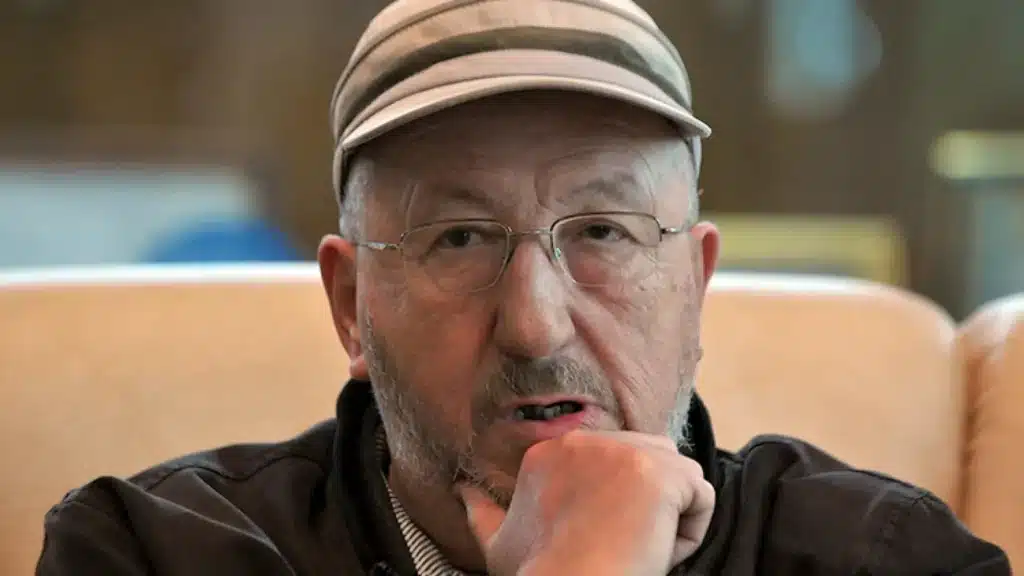
Even more troubling is the fact that this silence appears anything but incidental. It is fully consistent with the line pursued by Omar Takjout, the current Secretary-General of the UGTA, who since assuming office has steadily embraced a policy of praising the authorities and aligning himself with their discourse—despite the fact that those same authorities have hollowed out trade unionism and delivered repeated blows to what little remains of trade union rights and freedoms.
At a time when trade unionists are being imprisoned, independent organizations are being dissolved, and trade union activity is being criminalized through deeply unfair labor laws, the UGTA’s secretary-general has chosen to stand on the side of power—not as a social intermediary, but as a legitimizing façade for its failed and repressive policies.

Takjout vs. Sidi Saïd: Why the Current UGTA Leadership Marks a New Low
Many have described the era of Abdelmadjid Sidi Saïd as one defined by accommodation and collusion with the government—a characterization that is largely accurate. Yet the current reality compels a fuller and more uncomfortable truth: Omar Takjout represents a far greater danger than his predecessor.
While Sidi Saïd was internally subservient to the Bouteflika regime, he nonetheless invested externally in Algeria’s trade union image. He was—at least formally—mobilized to speak in the name of Africa in international forums, and he openly sought the position of Secretary-General of the International Trade Union Confederation (ITUC). To that end, he rallied dozens of African national trade union centers, triggering a significant political controversy within the world’s largest international trade union organization.
Today, under Takjout’s leadership, we are confronted with a model that combines internal submission with external exposure. It is a leadership devoid of international trade union ambition and lacking any willingness to position Africa for leadership within the International Trade Union Confederation , as his predecessor once attempted— despite the billions of dollars channeled by the Algerian state, and in turn by the UGTA itself, into the ITUC. What mirrors the flattery shown to power at home is an equal, if not greater, submission abroad.
When Solidarity Comes from Abroad, Silence Is Exposed at Home
The SUD-Rail statement, along with the solidarity of international trade union networks, did not only come to support Algerian trade unionists, but also revealed – without naming them – the isolation of the official union and its loss of its basic function. When the outside world takes it upon itself to expose the repression, while the inside remains silent, then the matter is no longer just a crisis, but a historical disgrace.
The silence of the Arab Trade Union Confederation and the International Trade Union Confederation is complicity in the crime
What is unfolding today in Algeria—the repression of trade unionists—cannot be separated from the troubling silence of both the International Trade Union Confederation (ITUC) and the Arab Trade Union Confederation. Both organizations were fully informed in advance of the facts of the case and of its political and trade union context. Such silence cannot be construed as neutrality; it amounts to indirect complicity, particularly when serious violations of trade union freedoms are at stake.
The most striking contradiction lies in the fact that Algeria’s independent trade unions—many of which are themselves affiliated with the ITUC—have for years been subjected to systematic marginalization and a complete absence of meaningful solidarity. Despite facing arbitrary dissolution, the criminalization of trade union activity, and the arrest of their leaders on terrorism-related charges, the ITUC has remained silent. Worse still, its Secretary-General paid an official visit to Algeria last February, during which he publicly praised the government and what he described as “social dialogue.” These statements were later exploited by the authorities to justify internal repression and to lend false legitimacy to their policies.
Even more perplexing is the fact that trade unionists from the General Union of Algerian Workers (UGTA) themselves—whose organization leads the ITUC’s regional structure, the Arab Trade Union Confederation—have received virtually no solidarity from that body, despite the arrest of prominent union leaders among them. This raises serious questions about the role, purpose, and credibility of the Arab Trade Union Confederation, particularly given the substantial financial resources it receives from multiple donors—resources that have failed to translate into real protection or support for trade unionists in times of crisis.
This reality confirms that the Arab trade union movement is facing a profound crisis—a structural crisis that goes beyond individuals and implicates the systems themselves. It calls for serious reflection on the need to build an alternative trade union force: independent, democratic, and principled. Even if launched with limited resources, such a force must be aligned with the aspirations of workers across the region and capable of taking clear, firm positions whenever trade union activity is repressed—particularly before the International Labour Organization, the Office of the UN High Commissioner for Human Rights, and other international institutions.

The Position ofthe Trade Union Confederation of Productive Forces (COSYFOP)
In this context, the President of the Trade Union Confederation of Productive Forces (COSYFOP) stated, in a declaration to the Confederation’s official website, that:
“The imprisonment of trade unionists is a political crime and a flagrant violation of Algeria’s international obligations. The silence of the General Union of Algerian Workers is a betrayal of its historical role and of its own activists. Today, rebuilding a free and independent trade union movement is no longer an option—it is an existential necessity for any genuine trade union activity in Algeria.”
He further stated:
“While we fully commend the French trade unions for their principled stand, what prevails domestically is not leadership or responsibility, but a disgraceful silence and exposed submission.”
Silence Is Not Neutrality — It Is Complicity
What is unfolding today within the General Union of Algerian Workers is not merely a leadership crisis; it is the collapse of a historic trade union function. When trade unionists are imprisoned and trade union activity is criminalized, silence becomes a fully-fledged political stance—one that cannot be justified by appeals to prudence or short-term calculations.
Solidarity expressed from abroad does not absolve those at home of their responsibility; it exposes it. History is unforgiving toward organizations that abandon their activists at moments of repression. Only a free, independent, and democratic trade union movement can restore the true meaning of trade unionism and put an end to a trajectory that has turned silence into policy and submission into an official line.
Read the following article for further details on the case.
📬 Did you like this article? Subscribe to our newsletter to receive the latest news and important information directly to your inbox.