🗓️Published on: 05/08/2026
How did a complaint that remained under examination for nearly a decade end without its core recommendations being implemented? What does the case reveal about the policy of attrition and the limits of international protection mechanisms?
The case of the Autonomous National Union of Postal Workers (SNAP) is one of the most significant Algerian trade union cases examined by the International Labour Organization’s Committee on Freedom of Association over the past two decades. Its importance lies both in the experience endured by postal workers and their union leaders and in the broader institutional questions it raises about the ability of the international supervisory system to protect trade unions operating in an authoritarian environment such as Algeria, where they face prolonged policies of restriction and attrition.
The immediate background to the case dates back to 2012, when the postal workers’ union, together with the union representing electricity and gas workers, the university teachers’ union and the National Autonomous Union of Public Administration Staff, submitted a joint complaint to the Committee on Freedom of Association under Case No. 2944. They called for independent trade unions to be granted legal registration in accordance with Algeria’s international obligations.
Some of these unions were subsequently registered. Their experience nevertheless demonstrated that a registration receipt does not necessarily amount to genuine recognition of a trade union, nor does it guarantee that the organization will be allowed to operate within workplaces and institutions. Several registered unions continued to face refusals by public administrations to engage with them, restrictions targeting their representatives and the denial of rights associated with trade union representation.
In the postal sector, the union submitted a new complaint in 2014, registered as Case No. 3104, concerning measures it considered discriminatory and retaliatory against its leaders, particularly union president Mourad Nekkache and media officer Ammar Khodja. Although the courts issued judgments ordering their reinstatement, those judgments remained unenforced and the consequences of their dismissal continued for years.
The case therefore evolved from an employment dispute within a public institution into a test of the effectiveness of international protection. Is it sufficient to establish that a violation has occurred and issue recommendations, or should the true value of those recommendations be measured by their ability to restore rights and protect the organization and its members against retaliation?
Legal and Supervisory Gains with No Practical Impact
At first, the case appeared to have achieved significant gains. The dismissed trade unionists obtained court judgments in their favour, while the Committee on Freedom of Association, in its reports concerning Case No. 3104, called upon the Algerian Government to take the necessary measures to enforce those judgments and remove the obstacles preventing the union from operating freely.
The Committee’s position was not limited to the issue of reinstatement. It also addressed postal workers’ right to join an organization of their own choosing and the need to protect them against discrimination or retaliation arising from trade union activity. The Committee further raised the issue of a public institution refusing to comply with court judgments without facing effective accountability or any meaningful deterrent consequences.
The absence of tangible progress, however, gradually reduced the follow-up process to a prolonged exchange of correspondence and procedural information concerning the enforcement of the judgments. As the years passed, the case lost much of its trade union and media momentum, while its principal recommendations remained incompletely implemented.
This does not mean that the Committee’s work was without value. Its reports provided international recognition of the concerns raised and established an important legal and institutional reference. The case nevertheless demonstrates how a favourable supervisory outcome can lose its practical value when recommendations are not accompanied by a follow-up process capable of responding to deliberate or persistent delays and protecting complainants against prolonged attrition.
Time and the Policy of Attrition
The experience of the postal workers’ union shows that the most damaging methods used against independent trade unionism do not always take the form of direct administrative dissolution or an explicit ban. They may instead involve gradually exhausting the organization and its leaders over a period of several years.
This policy combines dismissal and the loss of income with repeated judicial and administrative disputes and sustained security and professional pressure, imposing accumulating financial, psychological and family costs on trade unionists. Every additional year spent outside the workplace means greater economic insecurity, higher legal expenses and a further decline in the organization’s ability to retain its members and leaders.
This method becomes particularly harmful in an economic environment where opportunities for professional reintegration are limited, especially for trade unionists who have become publicly known for their positions. The loss of employment is then no longer a purely professional measure, but a means of pressure directed against the trade unionist and their family, making continued trade union involvement exceptionally costly.
From this perspective, time itself becomes an indirect instrument of repression. The longer the dispute continues, the weaker the victims’ ability to pursue it becomes, while the political cost borne by the responsible authorities remains limited, particularly in the absence of binding deadlines or enforcement mechanisms for the recommendations issued by international bodies.
2023: Continuing Violations and the Withdrawal of the Union Leadership
On 10 May 2023, the union issued a statement confirming that restrictions on trade union activity within Algérie Poste were continuing. The statement reported that the Secretary-General of the union’s Boumerdès branch had been suspended from work on 8 March 2023. According to the union, the suspension decision cited “membership in the Autonomous Union of Postal Workers” among the grounds for the measure.
The union regarded the decision as an act of intimidation directed at other employees and called upon the Labour Inspectorate and the competent authorities to intervene. Based on the information reviewed for this article, no effective measures appear to have been taken to remedy the consequences of the suspension or guarantee the protection of trade union activity. Law No. 23-02 governing the exercise of trade union rights was enacted several weeks after the incident. The issue is therefore not whether that legislation should have been applied retroactively, but whether its new protection mechanisms were subsequently used to address continuing discrimination and prevent similar violations from recurring.
Statement by the Autonomous National Union of Postal Workers concerning the dismissal of its Secretary-General
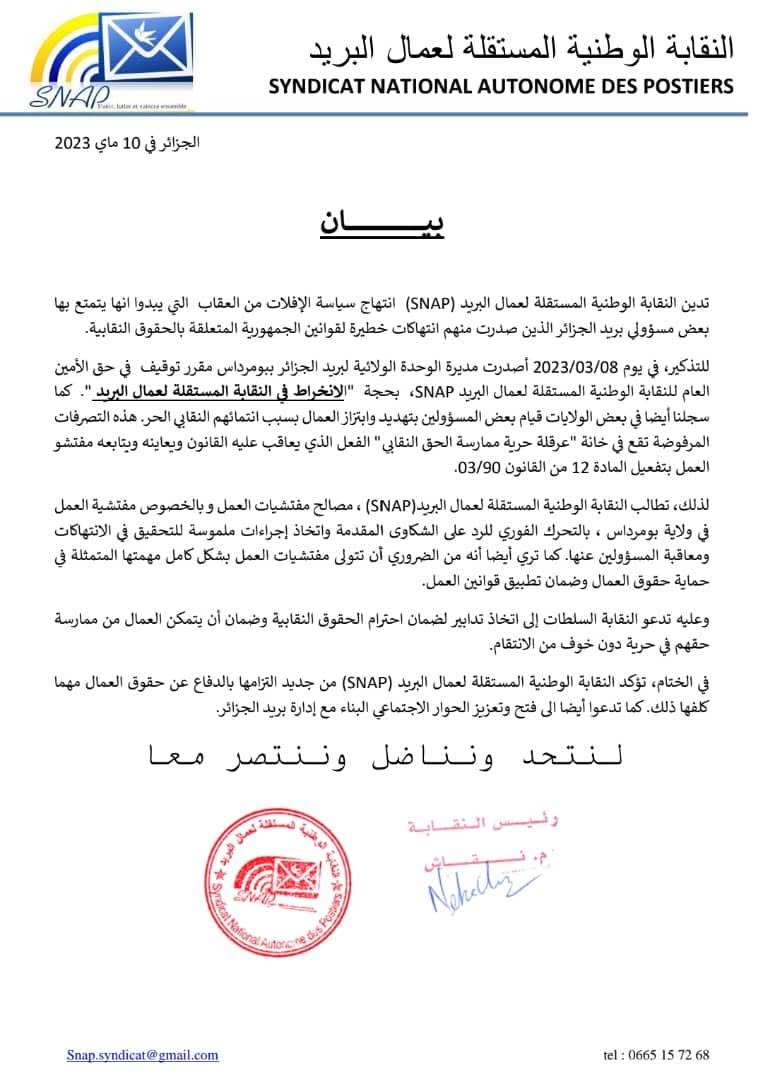
On 10 May 2023 Autonomous Union of Postal Workers of the Autonomous Union of Postal Workers stating 10 May 2023 had been dismissed on the groundsof his membership in the independent trade union..
This incident forms part of a broader pattern of practices targeting independent trade unionists across numerous public-sector industries in Algeria and highlights the continuing attempts to weaken free trade unionism and intimidate those who engage in it.
⚠️ Dismissing a trade union representative because of their union membership constitutes a direct violation of the principle of freedom of association guaranteed by ILO Convention No. 87, which Algeria has ratified.
A further turning point came on 3 August 2023, when union president Mourad Nekkache and media officer Ammar Khodja announced through the organization’s official page that they were resigning from their responsibilities and invited postal workers to assume the union’s leadership and continue the struggle. According to the announcement and the accompanying comments, their decision followed years of pressure and attrition and reflected a sense that solidarity among postal workers had become increasingly weak.
Based on publicly available information reviewed up to the date of publication, no new leadership capable of reviving the union’s activities has emerged, and the organization has not regained an active presence on the ground. Its legal existence has therefore continued without a functioning leadership structure or meaningful trade union activity, illustrating the distinction between registered trade union pluralism and genuine pluralism in which organizations are effectively able to organize and represent workers.
Announcement of the resignation of the President and Media Officer of the Autonomous Union of Postal Workers
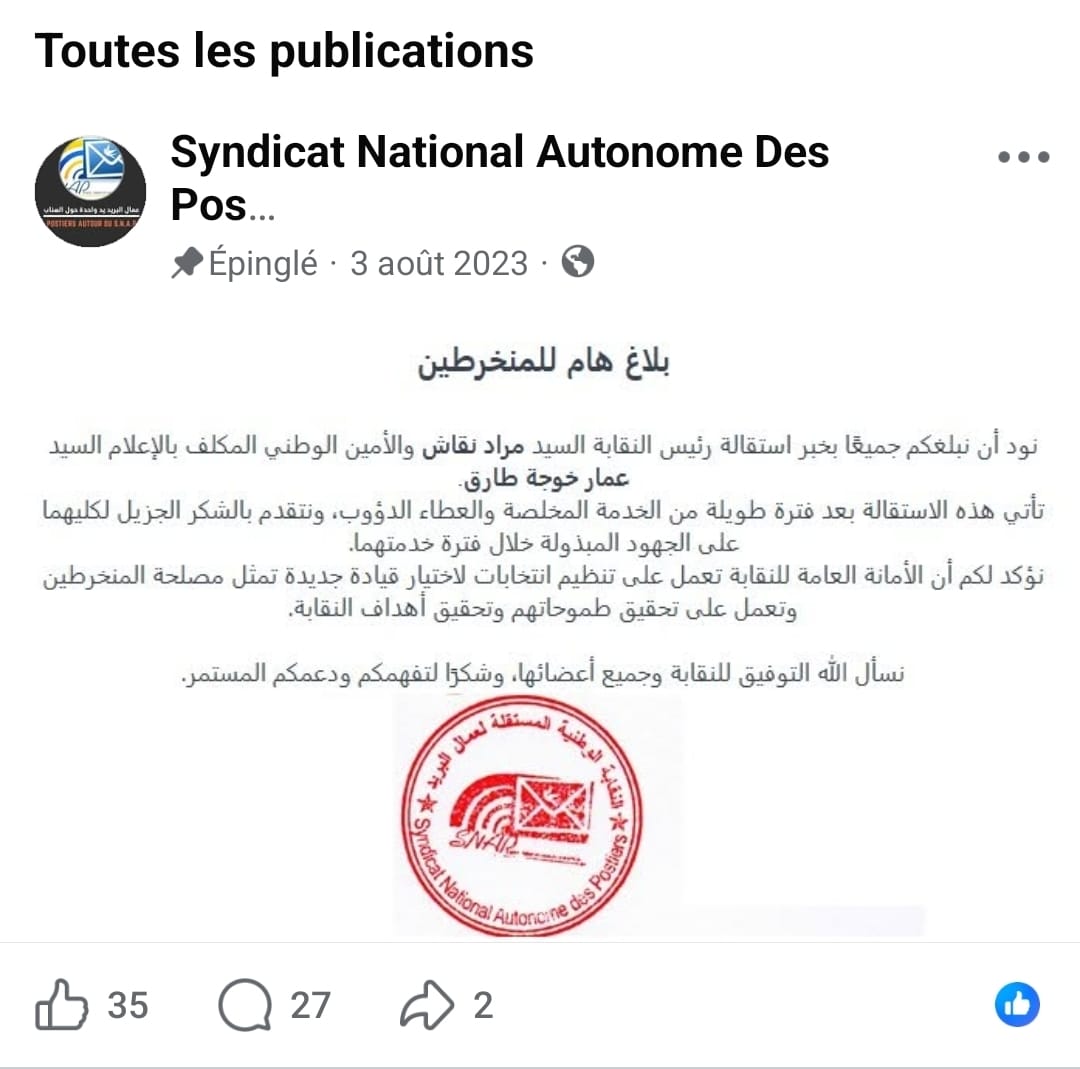
On 3 August 2023 Autonomous Union of Postal Workers of the Autonomous Union of Postal Workers stating 3 August 2023 , Mr Mourad Nekkache Mourad Nekkach, Mr Ammar Khodja had resignedpermanently from the union.
Following this announcement, the Autonomous Union of Postal Workers was officially left without representatives , after the departureof the two officials who had led the organization and spoken on its behalf.
⚠️ The simultaneous resignation of the President and the Media Officer leaves the union without a formal leadership structure, raising serious questions about the continued representation of workers in the sector and the future of their outstanding demands.
How Was the Case Closed by the Committee on Freedom of Association?
In its 404th Report, published in November 2023, the Committee on Freedom of Association listed Case No. 3104among the follow-up cases it had closed because no new information had been received from either party during the eighteen months following its previous examination of the case.
From a procedural standpoint, this form of closure does not mean that the recommendations were implemented or that the violations had ceased. It means only that the Committee ended its follow-up because no further information had been submitted to allow the examination to continue. This distinction is essential, as the closure of the case should not be interpreted as a substantive resolution of the dispute.
According to the content of the report, the March 2023 suspension of the local union official and the August 2023 resignations of Mourad Nekkache and Ammar Khodja were not among the developments considered by the Committee when it decided to close the case. The chronology therefore raises an important question: did the interruption of correspondence indicate that the underlying problem had been resolved, or did it result from the declining organizational capacity of those responsible for following up the complaint?
The report does not establish a direct causal relationship between the policy of attrition and the discontinuation of correspondence. This conclusion must therefore be presented as an interpretation based on the sequence of events rather than as an official finding made by the Committee. Nevertheless, the resignation of the organization’s representative who had maintained contact with the Committee, following years of dismissal and pressure, makes the possibility that the union was no longer able to pursue the case a legitimate matter for examination.
This is the central paradox of the case: it was closed procedurally, even though there was no evidence that the recommendations had been fully implemented or that the union had resumed its normal activities. The follow-up process ended when the complainants’ ability to continue pursuing it had declined, rather than when clear and effective redress had been secured for the victims.
The Limits of International Protection and the Need to Reform Follow-Up Procedures
The Committee on Freedom of Association is one of the International Labour Organization’s most important supervisory mechanisms. It was established to examine complaints concerning violations of freedom of association, including in countries that have not ratified the relevant ILO Conventions. The Committee is not, however, an international court and cannot impose direct sanctions or enforce its recommendations through coercive measures.
The effectiveness of its recommendations therefore depends, in addition to their legal and moral weight, on governments’ willingness to cooperate, their concern for their international reputation and the continuation of trade union, media and diplomatic pressure. These limitations are particularly apparent in authoritarian systems that are able to delay implementation, wear down complainants or prevent them from continuing to document violations and submit information.
This article does not attribute bad faith to the Committee, nor does it underestimate the importance of its work or its accumulated expertise. The criticism concerns the practical impact of certain follow-up rules when they are applied in the same manner to organizations operating in open environments and to organizations whose members face dismissal, arrest, threats or the dismantling of their structures.
If pressure attributable to the government or the institution against which a complaint was submitted results in the silencing of union representatives, and their subsequent silence then leads to the closure of the case, the procedural rule may unintentionally benefit the party facing the allegations. For this reason, the procedures governing the closure of cases originating from high-risk environments require serious institutional review.
Practical Proposals for Strengthening the Committee’s Procedures
The necessary review could begin with a number of realistic measures that would neither undermine the Committee’s tripartite character nor compromise its independence, but would instead enhance its ability to protect complainants:
1. Conduct a risk assessment before closing any case originating from a country in which restrictions on trade union freedoms have been documented, including verification of the situation of the organization’s representatives and their ability to communicate freely.
2. Do not rely exclusively on the absence of correspondence from the original complainant where credible indications exist that the violation is continuing, and allow relevant information to be submitted by international trade union federations or reliable national and international organizations with a connection to the case.
3. Establish an intermediate procedural status, such as “follow-up suspended due to an inability to maintain communication,” rather than permanently closing the case, allowing it to be reactivated rapidly when reliable information becomes available.
4. Develop secure and confidential communication channels and urgent procedures for cases in which complainants face a risk of retaliation because they have approached the International Labour Organization.
5. Before closing a case, request specific information from the government concerning the complainants’ safety and their professional and judicial situation, particularly where communication has ceased abruptly or at the same time as publicly reported indications of repression.
Modern methods of restricting trade union freedom do not always seek to eliminate an organization through a single decision. They may instead gradually weaken it until it disappears from the workplace while continuing to exist on paper. Follow-up mechanisms should therefore evolve from a system that merely waits for information into one that is more responsive to the risks that may prevent victims from providing it.
Lessons for Independent Trade Unions
The most important lesson from the postal workers’ case is that submitting an international complaint is not the end of the struggle, but its beginning. Regardless of how clearly it is formulated, a recommendation does not automatically restore rights. It requires sustained follow-up, regular documentation and long-term legal, financial and media support.
A case should also not be confined to a single international procedure. ILO mechanisms can be reinforced through engagement with United Nations procedures and regional human rights bodies, particularly the African Commission on Human and Peoples’ Rights, as well as through alliances with international trade union organizations, human rights groups and the media.
Responding effectively to a policy of attrition also requires institutional continuity within the union: files and responsibilities must be distributed, alternative leaders must be prepared, documents must be stored securely and more than one person must be capable of maintaining international communications. The targeting or resignation of a single representative should not result in the paralysis of the organization or the loss of its case.
The postal workers’ case extends far beyond one professional sector. It offers a broader lesson for Algeria’s independent trade union movement and for trade unions operating in every authoritarian environment: success should not be measured solely by obtaining an international recommendation, but by the extent to which that recommendation is converted into effective protection, the restoration of rights and safeguards against the recurrence of violations.
Statement by the President of the Trade Union Confederation of Productive Forces
The Trade Union Confederation of Productive Forces (COSYFOP) has followed the case of the Autonomous National Union of Postal Workers for several years. We regard it as a pivotal experience that exposes both the challenges facing independent trade unions and the limitations of international protection when violations are combined with a prolonged policy of attrition.
This case has taught us that, in the absence of continuous follow-up and coordination, time can become an instrument used against victims. It has also demonstrated that attempts to discredit trade unionists inside Algeria and abroad, or the use of certain international forums to improve the authorities’ image rather than address the substance of the violations, must not drive activists to withdraw, but should instead encourage stronger organization and greater collective action.
Organizations turning to the mechanisms of the International Labour Organization should adopt a long-term strategy from the outset, because relying on the expectation of a rapid solution may ultimately lead to frustration, loss of confidence and the discontinuation of correspondence, thereby allowing cases to be closed without their underlying causes being addressed.
Against this background, COSYFOP declares its readiness to place its expertise, documentation and international relationships at the disposal of efforts to examine the legal and institutional avenues for reactivating the case of the Autonomous National Union of Postal Workers, in coordination with the union’s former leadership and activists, whether before the Committee on Freedom of Association, United Nations mechanisms, the African Commission on Human and Peoples’ Rights or other competent bodies.
We also call for a serious debate within the international trade union movement and the International Labour Organization on strengthening follow-up procedures in cases originating from authoritarian states, so that the silencing or exhaustion of victims does not result in the procedural termination of their cases while the violations themselves continue.
Workers’ rights do not lapse merely because a case has been closed. Justice is not measured by the number of reports issued, but by whether victims receive redress, recommendations are implemented and safeguards are established to prevent violations from recurring. We remain convinced that solidarity, the exchange of experience and a critical assessment of previous cases can contribute to building more effective tools for protecting freedom of association and the dignity of workers.
Mourad Nekkache, President of the Autonomous Union of Postal Workers, exposes the dire situation and the violations faced by workers.
In this video Autonomous Union of Postal Workers describe Mourad Nekkach facing workers in the sector and expose a series of violations affecting the exercise of their trade union rights.
⚠️ This testimony must be viewed in the context of the union-related cases documented above: the dismissal of its Secretary-General because of his trade union membership, followed by the resignation of its President and Media Officer. Taken together, these developments reflect the broader pressure exerted on the union and its structures.
📬 Did you like this article? Subscribe to our newsletter to receive the latest news and important information directly to your inbox.