🗓️ Published: 9 July 2026
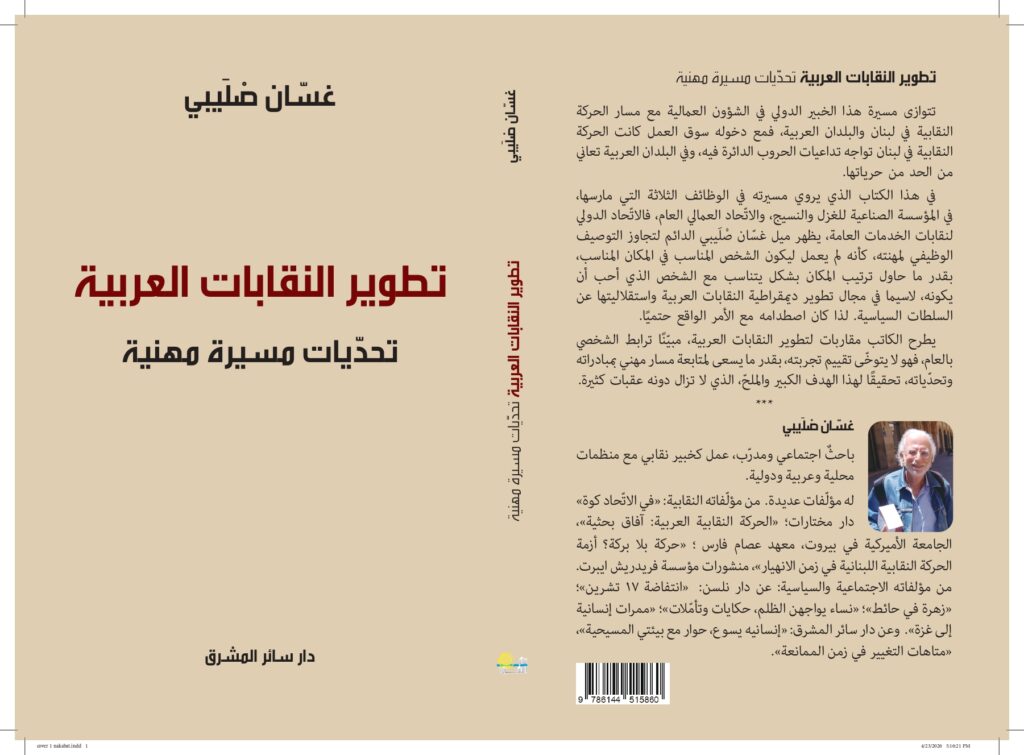
A reading of Dr. Ghassan Slaiby’s book and what the Algerian experience reveals about the crisis of independent trade unions in the Arab region
At first glance, this book may seem to be the professional memoir of a Lebanese trade unionist who spent many years working within Public Services International. A closer reading, however, reveals something much deeper. It is a testimony from inside a complex laboratory whose codes and mechanisms the Trade Union Confederation of Productive Forces has been trying to understand and decipher for years.
It is the laboratory of the difficult relationship between Arab trade unions, political authorities, international trade union organisations, and trade union solidarity projects — projects that often begin with ambitious slogans, but sometimes end at the limits of institutional calculations, the accommodation of official partners, and the balance of interests within the international trade union movement.
The value of this book does not lie only in the fact that it recounts a long personal experience. It places the reader, especially the Arab trade unionist, before a difficult question: what does it mean to support an independent trade union in a country that does not accept trade union independence in the first place? And what is the meaning of international solidarity if that solidarity stops at the first confrontation with a national union aligned with the authorities, or entrenched alongside a political regime that considers trade union freedom an existential threat?
Dr. Ghassan Slaiby does not write from the position of a theorist detached from reality. He writes as someone who tried, collided with obstacles, sometimes succeeded, sometimes failed, and then had the courage to revisit his own experience and share it with the public, with his friends, and especially with activists in North Africa and the Middle East. For that reason, the book offers neither a pure victory nor an absolute defeat. In my view, it offers something more valuable for any trade unionist: a critical analysis, and a courageous account of the complexities of trade union work in the Arab region and of the limits of international solidarity.
From a personal journey to the question of the trade union movement
Slaiby begins his book with his own personal experience, but he does not remain confined to it. From the textile factory, to the General Confederation of Lebanese Workers, and then to Public Services International, we follow a professional path haunted by one question, raised in different forms: how can Arab trade unions be developed in political, social and cultural environments that resist every attempt at independence or democratic organisation?
What impressed me in the book is the author’s clear commitment to trade union freedom, without simplification or exaggeration. He does not present the worker as revolutionary by nature, the independent trade union as a completed model simply because it declares itself independent, or international organisations and the International Labour Organization as saviours. Everything in this book is marked by contradiction: principles exist, but institutions hesitate; solidarity is needed, but it is conditional; independent trade unions carry a historic promise, but they are threatened from outside and from within at the same time.
This is where the book becomes important for us in Algeria. It does not only help us understand previous experiences; it also helps us define the impasse we live in today as trade unionists: the impasse of independent unions trying to survive under an authority that rejects pluralism and views it as an existential threat, while international organisations proclaim their commitment to defending trade union freedom but avoid confrontation with regimes when defending independent unions becomes politically or financially costly — especially when unions aligned with the authorities pay thousands of dollars each year to international organisations in membership fees.
Algeria: when international recognition becomes a form of protection
The part of the book that struck me most, and that I believe will also strike any researcher or observer interested in the Algerian trade union movement, is Slaiby’s discussion of independent trade unions in Algeria, particularly the National Autonomous Union of Public Administration Personnel, SNAPAP. In pages full of meaning, Slaiby recounts how he met the late trade unionist Rachid Malaoui, who died in exile in France in 2023, and how Malaoui expressed the union’s wish to join Public Services International after a previous request had been ignored.
This episode reveals the core of the relationship between independent trade unions and the international trade union movement. In a context such as Algeria, independent unions do not seek international membership for protocol or symbolic reasons. They seek external recognition that can provide a minimum level of political or moral protection and help break part of the national isolation imposed by the authorities and by the official union allied with them. In Algeria, as in Egypt and Jordan, the trade union struggle is not merely a professional dispute. It is a struggle over the right to organise freely and over the genuine representation of workers at the base. It is a struggle to make the worker a free citizen capable of building collective tools, rather than a subordinate trapped inside the closed official structure desired by the authorities.
For this reason, the experience of SNAPAP as presented in Slaiby’s book offers a key to understanding what other independent trade union organisations face today, including the Trade Union Confederation of Productive Forces. They face the same logic: a political authority seeking to monopolise representation, an official union benefiting from historical and international recognition, and an international trade union organisation still hesitating between the principle of trade union freedom and the calculations of its relationship with official actors.
International support: between solidarity and diplomatic courtesy
One of the most striking aspects of Slaiby’s book is that he does not simply praise the international support received by independent unions after the Arab Spring, as many books and studies on the region’s trade union movement often do. He also examines its limits and weaknesses. He recognises the importance of this support, but he also shows that, in many cases, it remains below the level of the challenges and dangers faced by independent unions. As presented in the book, international support may take the form of membership, training, media support, or assistance in filing complaints before the International Labour Organization. Yet it rarely becomes real protection when independent unions enter into direct confrontation with the authorities.
The problem, then, is not technical. It is not a lack of programmes, workshops or seminars. It goes much deeper. It can be summed up in a simple question: does the international trade union movement view independent unions in the Arab region merely as cases of violations requiring solidarity statements, or does it see them as a new historical phenomenon deserving a comprehensive strategy of protection and development?
In my view, this is the crucial distinction on which any analysis or strategy must be built. If independent unions are treated merely as victims of temporary violations, the international response will remain limited and routine: a letter to the government, a solidarity statement, a training session, or the inclusion of a complaint on an agenda. But if they are understood as the most important attempt the Arab region has seen in decades to move from unions orbiting around power to independent unions serving workers and society, then what is required becomes entirely different. The issue is no longer workshops or statements, but political recognition, international protection, organisational support, regional networking, sustained pressure on governments, and internal accountability for international unions when they retreat from the principles they claim to defend.
Why do international unions hesitate to support independent unions?
The question imposed by the Algerian reality today is this: why do international unions, foremost among them the International Trade Union Confederation, hesitate to provide clear and consistent support to independent unions?
Ghassan Slaiby does not offer a single answer to this question, but he gives us a set of keys that help explain this hesitation.
First, there is the accommodation of official national unions. Slaiby points out that official unions in many Arab countries still occupy influential positions within the international trade union movement, even when they lack independence or are politically linked to the authorities. Algeria appears to be a clear example of this reality. The Secretary General of the General Union of Algerian Workers, Amar Takdjout, holds the position of Vice-President of the International Trade Union Confederation, a position that gives him presence and influence within the organisation. In such a situation, recognising independent unions inside the ITUC becomes more complicated, because it raises a sensitive question: if there are independent unions that deserve recognition, does this mean that the official union does not have a monopoly over the representation of workers? This question alone is enough to explain part of the hesitation surrounding the file of independent unions in Algeria.
Second, there is the fear of clashing with the authorities. International trade union organisations, especially those running projects or maintaining institutional relations with governments, sometimes tend to avoid direct confrontation with regimes. This is particularly true because independent unions are precisely the ones confronting those regimes. For international unions, they therefore become the most sensitive file.
Third, there is a change in the very meaning of international trade union solidarity. This is one of the ideas that most struck me in the book. When solidarity becomes a funded project, it becomes governed by the logic of programmes, activities and reports more than by the spirit of trade union struggle. At that point, it becomes easier to organise a workshop on democracy or trade union independence than to engage in a real battle to defend an independent union facing repression or exclusion.
Fourth, there is the weakness of the regional role that the Arab Trade Union Confederation was supposed to play. Here, Slaiby offers a clear critique of this framework, which was supposed to be the natural regional home for independent unions in the Arab world, but which ended, in many cases, by accommodating official unions more than defending the unions that were created precisely in search of independence.
The Arab Trade Union Confederation: from expected home to hesitation
One of the harshest things revealed by the book is the tragedy of the Arab Trade Union Confederation. This body was supposed to be a regional home for independent unions in the Arab world. Yet in many stages, it appeared unable to play that role. Slaiby notes in his book the retreat of its support and the growth of its coordination with official national unions.
This shift is serious.Because of its position and its link with the International Trade Union Confederation, the Arab Trade Union Confederation could have become a tool of protection, coordination and advocacy for independent unions in Algeria, Egypt, Jordan and elsewhere. But when it becomes eager to accommodate official unions or avoid confrontation with them, it loses the very reason for which it historically existed.
What I take from the book on the question of the Arab Trade Union Confederation is that a new Arab trade union movement cannot be born from old calculations. Nor can trade union pluralism be defended while courting those who reject it. It is unfortunate to see the independent trade union movement paying the price of its independence twice: once before the authorities of its own countries, and once before an international trade union movement afraid to stand clearly on its side.
Independent unions: a historical phenomenon, not just new organisations
One of the ideas that most struck me in this book, and with which I largely agree, is that independent unions in Algeria, Egypt and Jordan represent a new trade union phenomenon, not merely additional organisations added to an existing trade union landscape. At their core, they are a serious attempt to break with the traditional model of trade unionism subordinated to power, and to build unions that draw their legitimacy from workers rather than from the state.
For this reason, the demands of these unions were not limited to wages or professional and social rights. From the outset, they were linked to questions of freedom, democracy and social justice. It is therefore natural that they should have been present at decisive political moments, such as the Egyptian revolution or the popular movement in Algeria; that they should have built links with civil society and human rights organisations inside and outside their countries; and that they should have paid a heavy price when the authorities saw them as a project going beyond the traditional trade union framework.
Another point I appreciated is that Ghassan Slaiby does not fall into the trap of glorifying independent unions or presenting them in an idealised form. He devotes an important part of the book to the internal challenges they face: weak resources, the pressure of exile, the difficulty of building broad trade union bases, divisions, lack of training, organisational exhaustion, and even the reproduction of some practices they had criticised within official unions.
In my view, these are among the most honest pages of the book, because they remind us that defending independent unions does not mean exempting them from criticism. It means helping them become more capable of embodying the principles for which they were created. As an Algerian trade unionist, I find myself in agreement with this vision. Trade union independence is not a slogan to be raised, nor a status acquired merely by declaring the creation of an independent union. It is a daily practice that begins with internal democracy, financial transparency, the fight against corruption, the building of a real relationship with workers at the base, the empowerment of women and young people in positions of responsibility, and the consolidation of a culture of criticism and accountability. It also requires the ability to turn international solidarity into a factor that strengthens the organisation internally, rather than a substitute for trade union work on the ground.
From training to confrontation: the main lesson of the book
One of the most important points Slaiby raises in his book is his distinction between three approaches to trade union independence: ignoring the issue, limiting it to theoretical training, or turning it into an actual plan for confrontation.
This, in my view, is the heart of the matter. Trade union independence is not acquired through a training course on independence or democracy. It is tested when a union demands its right to registration, rejects interference by the administration, confronts a repressive law, defends a leader who is prosecuted, imprisoned or dismissed, or insists on representing a category of workers that the authorities do not want to have a voice.
Only then does the real question become clear: are international unions partners in the confrontation, or merely supporters of activities? Do they stand with the union when it pays the price, or do they limit themselves to training it on principles they will not defend when those principles are violated?
For independent unions in Algeria, this is not a theoretical question. Trade union leaders have paid the price of their activism through imprisonment, judicial prosecution, administrative harassment, exile, smear campaigns and dismissal from work. In many cases, when the national space was closed, trade unionists had no option left but to internationalise their struggle before the International Labour Organization, the United Nations, human rights mechanisms and international networks.
But internationalisation here is not a retreat from the national struggle, as some may believe. It is the continuation of that struggle by other means when the national arena becomes closed or mined. For this reason, it is neither morally nor politically acceptable to demand that independent unions face this reality alone, while international unions hesitate to provide the cover that they themselves consider part of their mission.
The persistence of the Algerian impasse
What the experience of SNAPAP reveals in Ghassan Slaiby’s book does not belong to a period that has ended. It helps us understand the impasse that the independent trade union movement in Algeria still faces today. What SNAPAP faced yesterday is now faced by other independent organisations, including the Trade Union Confederation of Productive Forces, particularly on the issues of legal recognition, protection, and the relationship with the international trade union movement.
In Algeria, the problem has never been only the absence of legal texts. It has also been the absence of political will to entrench trade union freedom and to apply the law itself. Even when the law provides a certain margin, that margin is often narrowed through administrative measures, security-based interpretations, or discriminatory application. In such a context, the position of the international trade union movement becomes a decisive factor in the future of independent unions. Silence or hesitation does not remain neutral; in practice, it affects the balance of power between independent unions and official unions.
If today you were to ask the International Trade Union Confederation or the Arab Trade Union Confederation a simple question — are you in favour of trade union freedom? — no one would hesitate to answer yes. But after reading Ghassan Slaiby’s book, I realised that this is not the essential question.
The real question for the international trade union movement is this: what do you do when trade union freedom moves from being a principle proclaimed in your statements to a battle on the ground? What is your position when an independent union finds itself facing an official union that occupies an influential position within your own organisation? Is priority given to defending the principle, or to preserving balances within the international trade union movement? And does your commitment to trade union freedom translate into practical positions when the cost of that commitment becomes high?
Towards a new strategy for trade union solidarity
The lesson I draw from Ghassan Slaiby’s book, especially on the question of independent unions that concerns me personally, is that they do not need seasonal solidarity. They need a long-term strategy.
Such a strategy should rest on seven pillars.
First, clear political and trade union recognition of serious independent unions, without making that recognition dependent on the approval of official unions or governments.
Second, transforming complaints before the International Labour Organization from technical procedures into international trade union campaigns involving media work, pressure and follow-up.
Third, strengthening the internal organisation of independent unions, not only their rights-based discourse. A union that does not build a base cannot withstand pressure, however strong international support may be.
Fourth, protecting threatened trade union leaders through clear international networks, not through scattered statements after the damage has already been done.
Fifth, creating an independent Arab space for coordination among independent unions, away from the domination of official unions and bureaucratic calculations.
Sixth, linking trade union work to human rights and democratic movements and organisations, because the repression of independent unions in the Arab region is not only a social issue; it is part of a broader structure of repression against free civil society.
Seventh, holding international unions themselves accountable through their committed members when they retreat or compromise. Solidarity has no meaning if accountability applies only to governments while international trade union organisations are exempted from their own responsibilities.
When survival becomes an act of resistance
The value of Ghassan Slaiby’s book is that it does not sell illusions. It does not say that independent unions will win simply because they are right. Nor does it say that international unions always stand with the oppressed simply because they raise beautiful slogans.
Through his experience, the author reminds us that real trade union work is a long struggle between hope and defeat, between principles and calculations, between organisation and repression, and between solidarity as a value and solidarity as the management of projects.
For the independent trade union movement in Algeria, this book matters because it gives us a clearer language with which to understand what we are living. We are not only facing a national authority hostile to trade union pluralism. We are also facing an international trade union system that has not always settled its position on independent unions when protecting them becomes politically costly.
Yet the book does not lead us to despair. On the contrary, it reminds us that every independent experience, however besieged it may appear, leaves a mark. SNAPAP left a mark. Independent unions in Egypt and Jordan left a mark. Today, the Trade Union Confederation of Productive Forces and all independent organisations in Algeria must continue to turn siege into a cause, exile into a platform, and internationalisation into an extension of struggle, not a substitute for it.
When all channels of local negotiation are closed, internationalisation becomes a continuation of struggle, not an abandonment of it. And when survival itself becomes a battle, every independent union that stands firm, and every trade union voice that refuses subordination, becomes part of a future that has not yet been born, but insists on being born.
Finally, researchers and trade unionists may disagree with many of Ghassan Slaiby’s conclusions, and the readings built on his experience may also differ. Yet the real value of this book, in my view, does not lie in the solutions it offers, but in the problems it raises. Slaiby does not claim to have found the formula capable of developing Arab trade unions. Rather, he presents to the reader his attempts to understand these problems and deal with them. At some moments, he appears to have succeeded; at others, he acknowledges, implicitly or explicitly, that the experience had reached its limits. Perhaps his resignation from Public Services International is the clearest indication that the questions he faced were too complex to be resolved by the will of one person or one institution.
For this reason, I do not see this book as the end of a debate. I see it as the beginning of an important debate on the democratisation of trade union and social life in North Africa and the Middle East. I therefore hope that it will encourage Arab and international researchers and academics to approach these questions scientifically, and to subject them to study, analysis and comparison. The future of independent unions in the Arab region will not be built on slogans alone, but on a deep scientific understanding of the challenges they face, and of the limits and possibilities of international trade union solidarity.
By Raouf Mellal
President of the Trade Union Confederation of Productive Forces (COSYFOP)
The book can be purchased through Amazon - From here
📬 Did you like this article? Subscribe to our newsletter to receive the latest news and important information directly to your inbox.