🗓️ Published on: 26/02/2026
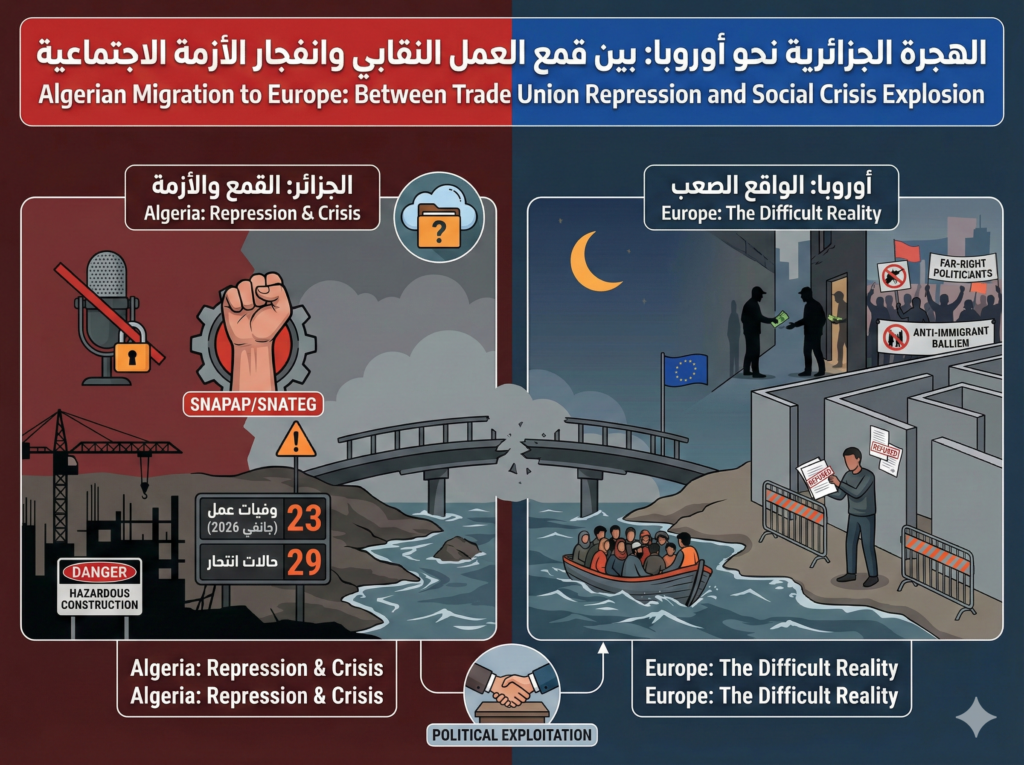
The increasing arrival of boats carrying Algerian migrants to Spanish shores in recent weeks—particularly at the beginning of the holy month of Ramadan—is not merely a temporary development. It reflects the accumulation of deep structural crises within Algeria. While economic hardship is often cited as the primary explanation, economic factors alone do not fully account for this trend. Trade union repression, human rights restrictions, and social deterioration are also central drivers behind this ongoing human outflow.
Trade Union Repression as a Push Factor
In recent years, independent and activist trade unions have been subjected to systematic pressure, particularly those affiliated with the Trade Union Confederation of Productive Forces (COSYFOP), notably SNAPAP and SNATEG .
Restrictions on union activity, the dissolution of union structures, legal and judicial pressure targeting trade unionists, and administrative pressure targeting trade unionists have collectively weakened workers’ ability to defend their rights. The immediate consequences include reduced bargaining power, weaker oversight of occupational safety standards, and increasingly precarious working conditions—especially in construction, energy, and public works.
Alarming Indicators
According to data documented by the Confederation, 23 workplace fatalities were recorded in the first month of 2026 alone, most of them at construction sites. During the same period, 29 suicides were also recorded, some of them in particularly disturbing circumstances documented on social media.
Although partial, these figures reflect severe social and psychological pressure within working communities and society more broadly. More concerning is the absence of an independent and transparent body publishing reliable official statistics on workplace fatalities and suicides. This suggests that the real numbers may be significantly higher.
The lack of statistical transparency is not merely a technical issue. It contributes to concealing the depth of the crisis and prevents the development of effective preventive policies, as conditions continue to deteriorate at a pace not seen since Algeria’s civil war.
From Workplace Insecurity to the Decision to Migrate
When workers are deprived of independent trade union protection, effective grievance mechanisms, safe working conditions, and economic stability, migration ceases to be purely an economic decision—it becomes a psychological and social escape.
A survey conducted by the Confederation among Algerian migrants in France, Switzerland, and Spain indicates that many did not leave solely because of unemployment. They were also fleeing unsafe working environments, judicial or administrative pressure, and a broader sense of collective powerlessness resulting from the dismantling of independent labor representation.
Psychological Shock After Arrival in Europe
Paradoxically, many young migrants arrive in Europe already carrying complex psychological burdens shaped by prior social tension, economic pressure, and in some cases legal prosecution. They seek stability and dignified employment but instead encounter new forms of precarity, including legal uncertainty, slow asylum procedures, and restrictive administrative systems.
In the absence of rapid integration and adequate psychological and social support, some are pushed into informal work or marginal criminal activities such as petty theft and minor violence.
Although relatively limited, these phenomena are politically exploited within Europe, contributing to the rise of far-right narratives that call for stricter border controls and harsher migration policies.
The tragic result is that young people who deserve protection or legal regularization become victims of generalized political hardening that fails to distinguish between individual circumstances.
Migration as a Political Lever in Algeria–Europe Relations
Algeria increasingly uses migration as a tool of procedural leverage in its relations with European partners. Legal requirements—such as the obligation to exhaust all appeals—are transformed from safeguards into instruments for regulating consular cooperation and advancing broader political and diplomatic objectives. A recent example of this dynamic can be seen in the diplomatic tensions with France in the case commonly referred to as the Boualem case..
The Algerian government’s approach appears to follow a “cooperation in exchange for alignment” logic. The willingness to readmit migrants is closely linked to the degree of convergence between European positions and Algerian interests on sensitive issues, including historical memory and regional disputes. In this context, Algerian migrants effectively become silent actors in broader diplomatic negotiations.
This strategy also capitalizes on European security concerns regarding migration flows, providing Algeria with leverage in negotiations over visas, energy, and political relations—transforming migration from an administrative matter into an instrument of geopolitical bargaining.
However, this politicization of migration risks triggering countermeasures from European governments, including visa restrictions, ultimately turning migration into an extension of diplomatic tensions rather than addressing its underlying human causes.
Statistical Opacity and the Worsening Crisis
The withholding of official data on workplace deaths and suicides reflects a form of statistical containment aimed at avoiding recognition of deteriorating labor conditions. This transforms what could be addressed as a public policy issue into a deeper governance crisis.
Without transparent and reliable data , trade unions and civil society lack the evidence necessary to advocate for meaningful reforms. Safety reports remain inaccessible, independent oversight is absent, and accountability mechanisms are weakened.
This opacity reflects a broader governance failure in which information is treated as a political liability rather than a tool for public policy planning. As a result, the gap between official narratives and lived realities continues to widen.
The deliberate policy of withholding or obscuring statistical data is itself a symptom of systemic governance dysfunction. When information is perceived as a political threat rather than a planning instrument, the distance between declared realities and conditions on the ground grows wider with every undocumented workplace injury or unreported suicide.
A Shared Responsibility
In meetings with policymakers, trade union representatives, and human rights organizations in Europe, Confederation President Raouf Mellal emphasized that migration cannot be reduced to a security issue alone. European partners should support the restoration of independent trade union freedoms as a preventive measure, while encouraging Algeria to ensure transparency in labor and safety data. Addressing migration requires tackling its structural causes rather than merely managing its consequences.
He also stressed the importance of engagement by the Algerian diaspora in Europe, particularly civil society and human rights organizations, in fostering serious discussion about the structural drivers of migration and the risks of its political instrumentalization.
In this context, Confederation President Raouf Mellal stated:
“Migration is not a voluntary choice—it is the direct result of repression, deteriorating working conditions, and the denial of trade union rights. When workers lose protection, dignity, and hope, they are pushed to leave in search of safety, dignity, and justice. The solution lies in restoring trade union freedoms, protecting workers’ rights, and creating the conditions for people to live and work with dignity in their own country.”
📬 Did you like this article? Subscribe to our newsletter to receive the latest news and important information directly to your inbox.